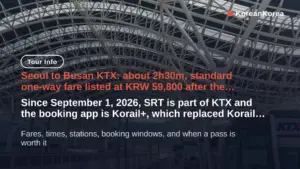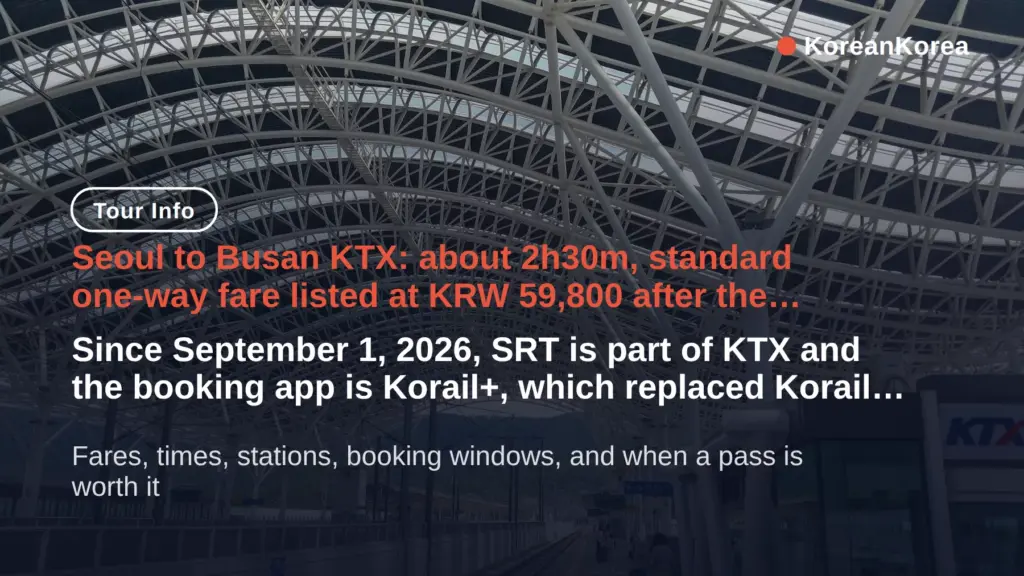
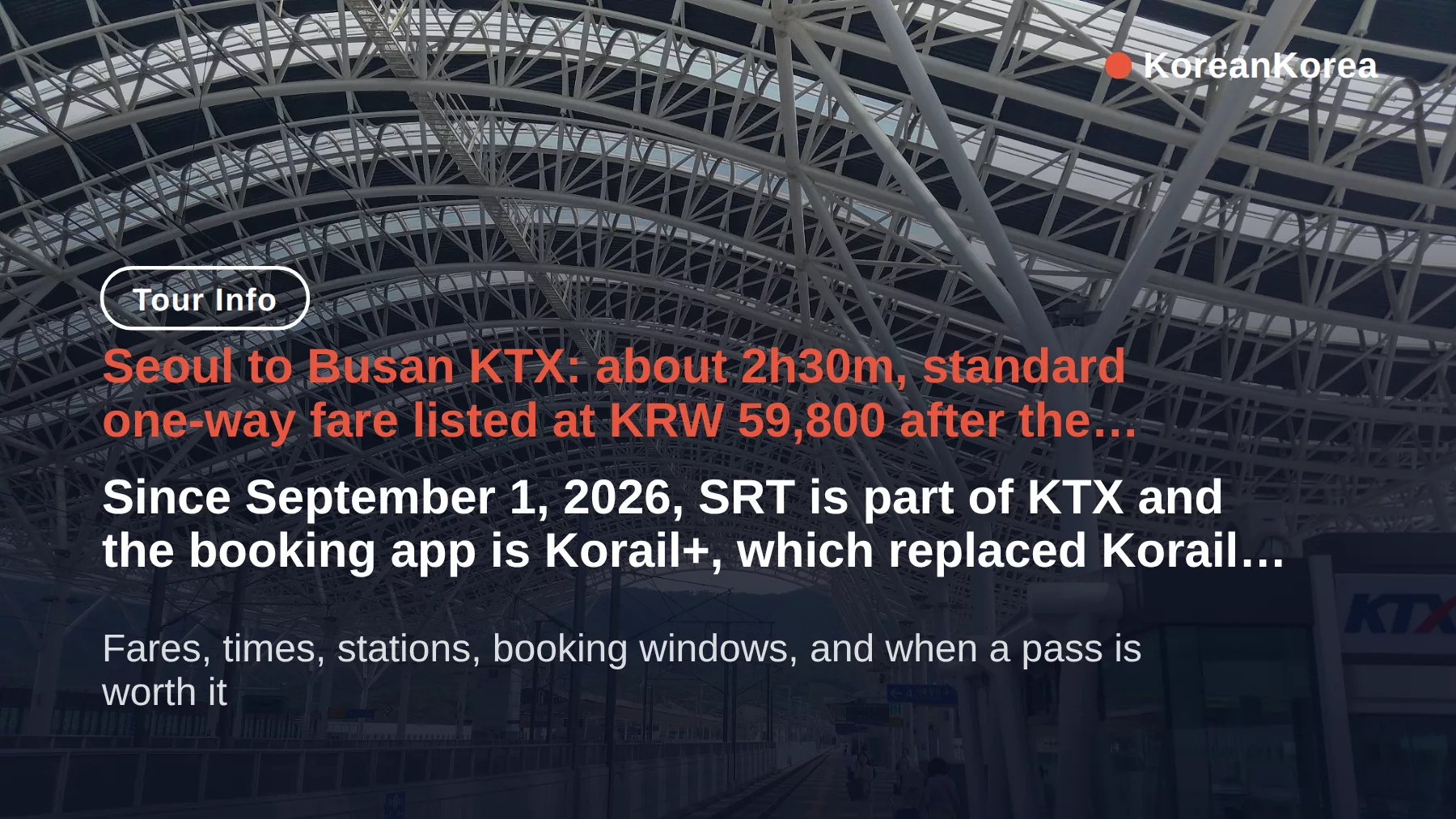
The Seoul to Busan KTX takes about 2h30m, and the standard one-way fare is listed at KRW 59,800 in a 2026 source dated after the September fare cut — though another 2026 source still lists KRW 53,900, so check the fare in the app before paying.
That September 1 change also matters for booking: SRT merged into the KTX brand, fares dropped about 10% on average, and the Korail+ app replaced Korail Talk with 7-language support, so older booking guides no longer match the app you will download.
This post covers the fare (and the conflict), the new app, how pricing works, stations and schedules, when a pass beats single tickets, and how the KTX compares with the bus, the slow train, and a flight.
Contents
- seoul to busan ktx price: KRW 59,800 after the September cut
- What changed on September 1, 2026: SRT merged into KTX, and the app is now Korail+
- Do KTX tickets get cheaper if you book early?
- Which station, how often, and how do kids’ fares work?
- Do you need a KR PASS?
- KTX vs bus, slow train, and plane — and getting into Busan
seoul to busan ktx price: KRW 59,800 after the September cut
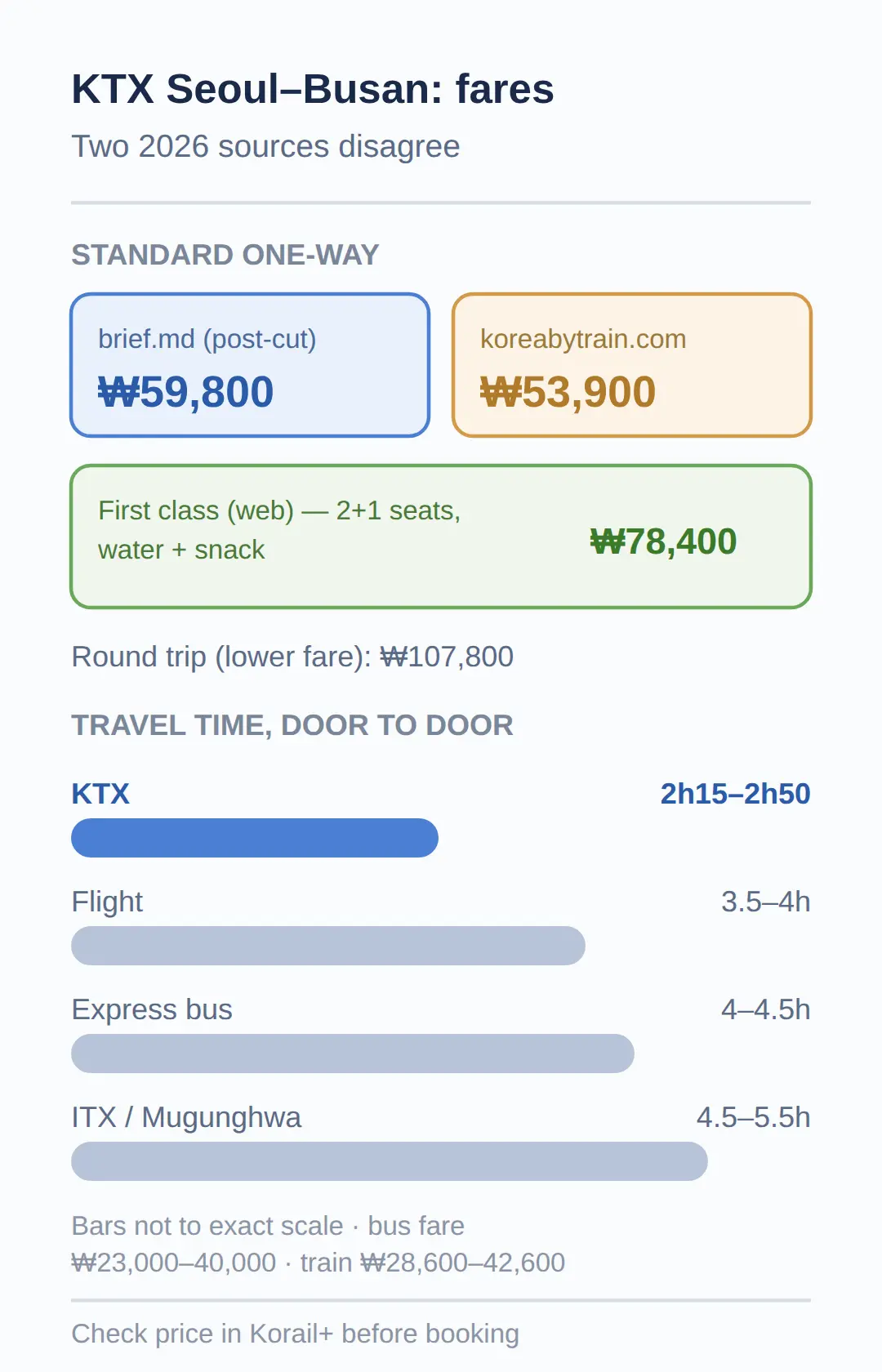
The standard one-way fare is listed at KRW 59,800 in a 2026 source reflecting the post-September fare cut, while a second 2026 source lists KRW 53,900 — the two figures have not been reconciled against an official Korail fare page.
Per the 2026 figures on koreabytrain.com, first class is about KRW 78,400 one-way, with 2+1 seating and a water and snack included, so it costs roughly KRW 23,900–24,500 more than standard.
The round trip on standard works out to KRW 107,800 (2 × 53,900) on the source that uses the lower figure.
The fastest trains run the roughly 420km Gyeongbu route in about 2h15m, and most trains take 2h30m–2h50m, city center to city center.
Because the two fare figures conflict, the first thing to check in the Korail+ app is the actual price for your date and train before you budget the trip.
If you are only comparing against other transport, the fare still sits far below a same-day flight and buys you about two hours of saved time over the bus.
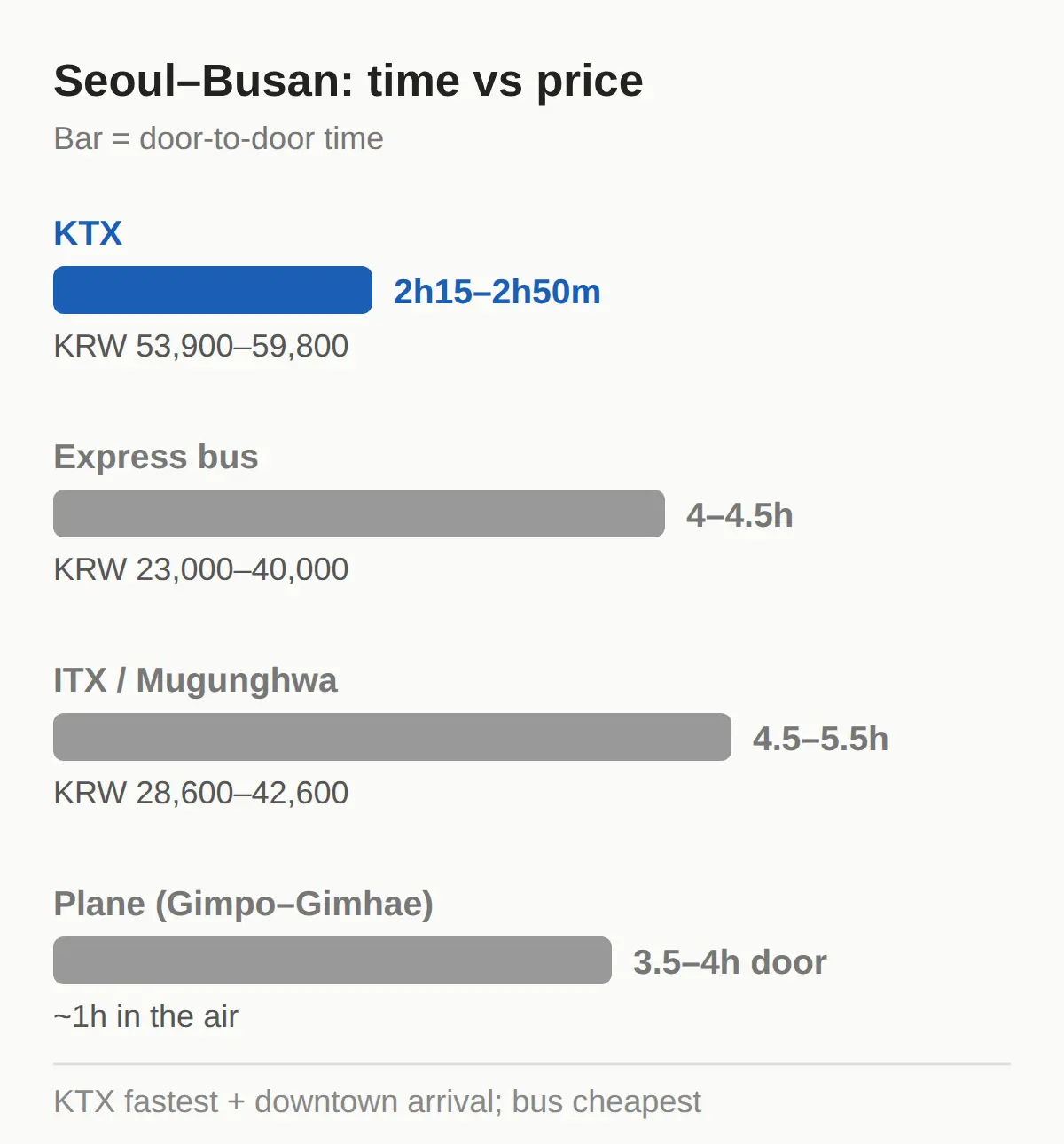
| KTX (Gyeongbu line) | 2h15m–2h50m, city center to city center |
|---|---|
| Express bus | 4–4.5h, KRW 23,000–40,000 |
| ITX-Saemaeul / Mugunghwa | 4.5–5.5h, KRW 28,600–42,600 |
| Plane (Gimpo–Gimhae) | About 1h in the air, 3.5–4h door to door |
What changed on September 1, 2026: SRT merged into KTX, and the app is now Korail+
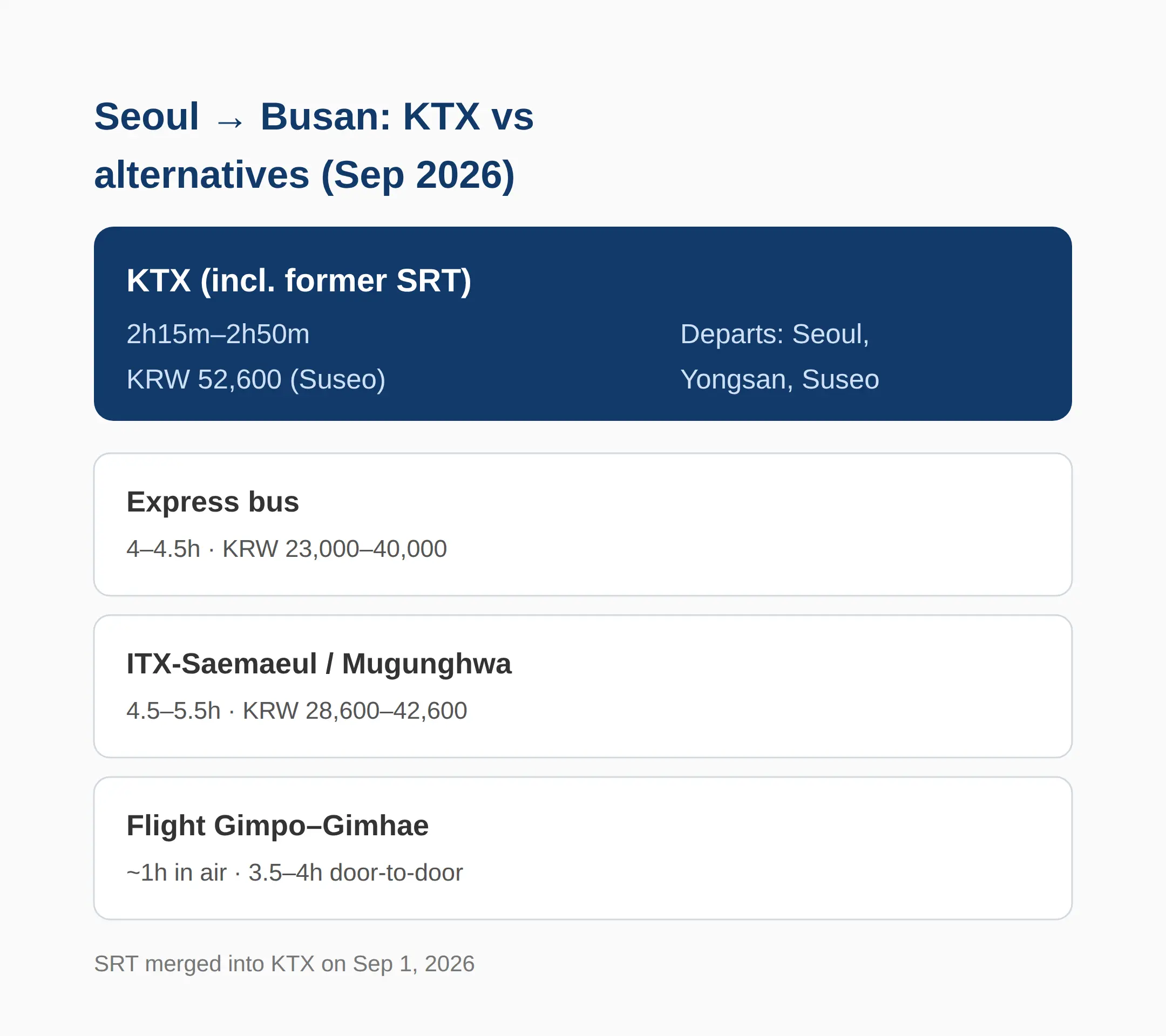
From September 1, 2026, SRT is part of the KTX brand, average fares were cut about 10%, and the Korail+ app replaced Korail Talk with booking in 7 languages.
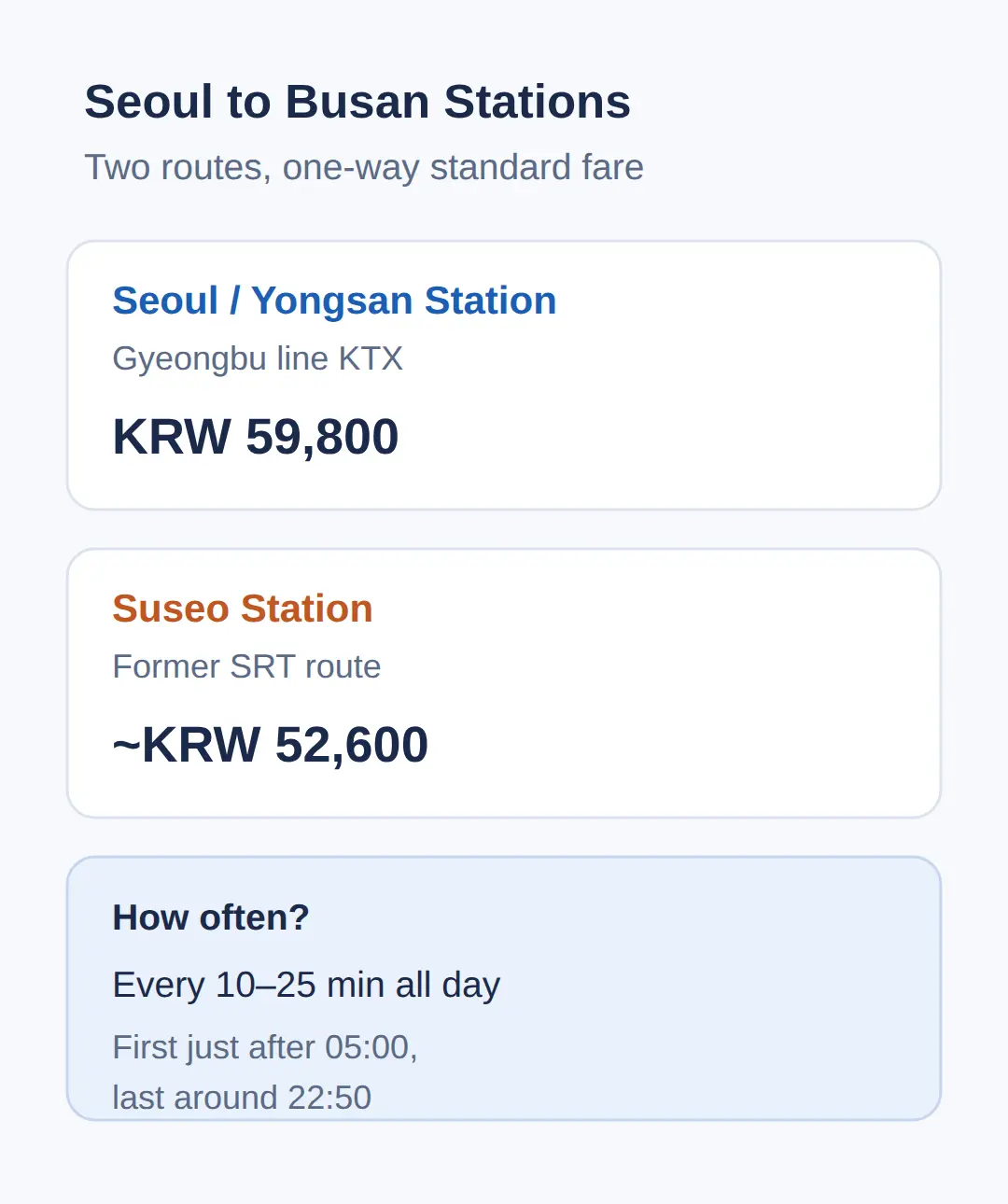
For you as a traveler, that means trains to Busan also leave from Suseo Station, where a one-way fare is listed at about KRW 52,600, alongside the usual Seoul and Yongsan departures.
The app switch is the reason older booking guides are wrong now: any step-by-step written for Korail Talk may not match the Korail+ screens.
For a foreign traveler, the 7-language support in Korail+ is the practical point — the exact English booking flow has not been confirmed from a primary page, so expect to match what the app shows at each step.
If you booked with Korail Talk on a previous trip, download Korail+ fresh rather than updating your memory of the old app.
Do KTX tickets get cheaper if you book early?
No — Korail uses no dynamic pricing, so the fare is the same whether you book 30 days ahead or 30 minutes before departure.
What changes over time is the seat count: reservations open about 30 days before departure, and on holiday peaks it is seats, not price, that runs out.
There is one way the fare itself can drop: Korail sells discounted online special fares on selected seats of low-demand trains, so on an off-peak departure the cheap fare disappears rather than the seat.
Membership points and the ‘Himnaera Cheongchun’ youth fare are also mentioned as discounts, but the details have not been verified — check the fare conditions in the app for your date.
So if your dates are fixed and the train is popular, book early for the seat; if you are flexible on departure time, it pays to look for the discounted seats.
Which station, how often, and how do kids’ fares work?
Trains leave from Seoul Station and Yongsan Station on the Gyeongbu line via Daejeon and Dongdaegu, and Suseo Station also serves Busan.
Trains run every 10–25 minutes all day; the first departs just after 05:00 and the last around 22:50.
Children ride cheap: under 6 is free on your lap, and ages 6–12 pay half price.
Before searching, set the exact origin, destination, and date in the Korail website or app, because dozens of departures daily means times vary by train, not just by hour.
If you miss the last KTX around 22:50, your same-day options drop to the bus or an overnight stay, so check the return time before you book a late dinner in Busan.
Do you need a KR PASS?
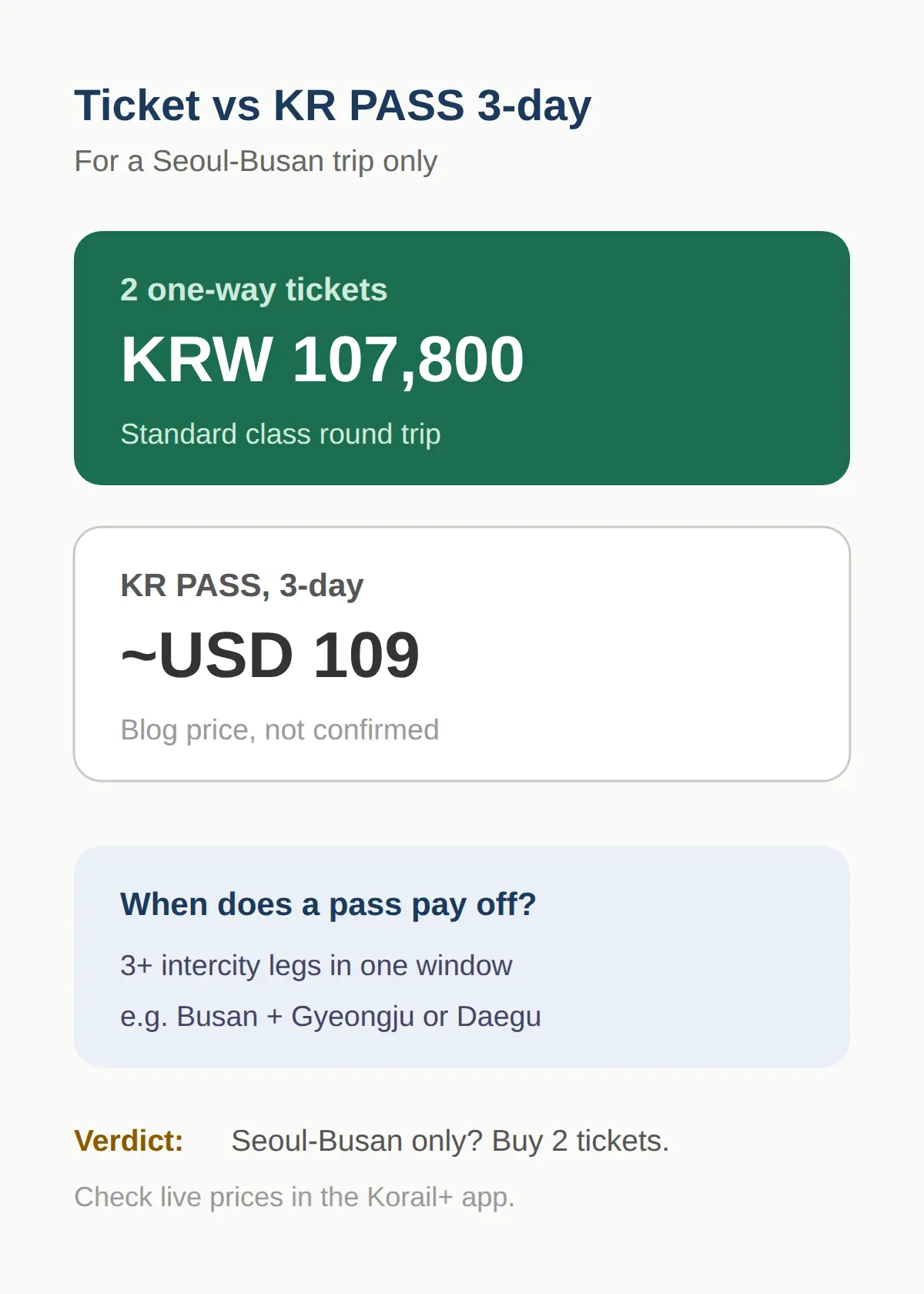
If Seoul⇄Busan is your only intercity trip, individual tickets are cheaper than any pass — the standard round trip is KRW 107,800.
A KR PASS 3-day pass is listed at about USD 109 on a blog, but that figure has not been confirmed on an official Korail page, so compare it against the app’s live price before deciding.
The pass only starts to make sense when you have 3 or more intercity legs, because each extra leg stacks against the pass price while single tickets add up linearly.
If you are pairing Busan with Gyeongju, Daejeon, or Daegu in the same window, price both ways in the app and pick the smaller total.
For a simple Seoul⇄Busan weekend, buying two one-way tickets is the shorter path.
KTX vs bus, slow train, and plane — and getting into Busan
The KTX is the fastest and mid-priced option: 2h15m–2h50m versus the express bus at 4–4.5h and KRW 23,000–40,000, the ITX-Saemaeul/Mugunghwa at 4.5–5.5h and KRW 28,600–42,600, or a Gimpo–Gimhae flight that is about 1h in the air but 3.5–4h door to door.
On a tight budget, the bus saves you about KRW 30,900 against the KTX fare and costs you roughly 2 hours more.
Busan Station is downtown, which is the hidden advantage of the train: Metro Line 1 is connected to the station, Seomyeon is about 15 minutes, and Nampo-dong and Jagalchi Market are 2–3 stops away.
Haeundae takes 25–40 minutes by taxi or about 45 minutes by metro with one transfer.
If you want the ride itself to be the sightseeing, the KTX-Eum via Gangneung takes about 5h30m along the East Sea coast — a much slower scenic option than the Gyeongbu line.
If I were traveling only Seoul⇄Busan, I would buy two individual tickets, because at about KRW 107,800 round trip no pass can beat them for a single intercity leg.
What I check first is the app price on the day, since two 2026 sources still disagree between KRW 53,900 and KRW 59,800.
So pick the KTX for speed from city center to city center, the bus for the lowest fare, and the plane only when a schedule gap makes the 3.5–4h door-to-door math work.
Related posts
📎 Seoul — everything we know
📎 📅 다가오는 일정 — 발매·개봉·발표 캘린더
Sources
- KRW 53,900 standard, 78,400 first class, fixed pricing, 30-d (koreabytrain.com)
- Approx USD 109 (blog source, low confidence) (visit-korea-guide.tistory.com)
- Already covered in existing 26 facts (SRT integration, Korai (lacha.co.kr)
How to decide in one table
- Buying only Seoul⇄Busan and nothing else between cities → buy two individual tickets; the KRW 107,800 round trip beats any pass.
- Traveling on a Friday evening → expect sellouts on peak trains, while Tuesday morning trains can often still be bought same-day at the station.
- Standard class sold out on a peak train → check first class; it is about KRW 23,900–24,500 more one-way and often still has seats.
- Booking as a foreigner → use the Korail+ app, which replaced Korail Talk on September 1, 2026 and supports 7 languages.
- On a tight budget and not in a hurry → take the express bus and save about KRW 30,900 for about 2 extra hours.
FAQ
Q. How much is the Seoul to Busan KTX?
A 2026 source reflecting the September fare cut lists KRW 59,800 one-way standard; another 2026 source lists KRW 53,900. Check the price in the Korail+ app before booking.
Q. Should I book Seoul to Busan KTX tickets in advance, or can I buy them same-day at the station?
Both figures come from secondary 2026 sources and no official Korail fare page confirmed either one in the sources behind this post, so the app’s price at booking is the one to trust.
Q. Does booking early make KTX tickets cheaper, or do only seats sell out?
Only seats disappear. Korail uses no dynamic pricing, so the fare is identical booked 30 days ahead or 30 minutes before; only discounted online special fares on low-demand trains change the price.
Q. What changed with KTX booking in September 2026?
SRT merged into the KTX brand on September 1, 2026, average fares fell about 10%, and the Korail+ app replaced Korail Talk with 7-language booking.
Q. How much is a Seoul to Busan KTX round trip, and can I book it in the Korail+ app?
The standard round trip is KRW 107,800 (2 × 53,900) on the lower 2026 figure, and yes — booking runs through the Korail+ app, which supports 7 languages.
During holiday peaks, seats — not prices — are the constraint, so book the moment your date opens 30 days out.
30 days before any departure: reservations open; set a reminder for your travel date.
Cover photo: <div class=’fn’> August In Gyeongju</div> by Eric Cosmides — CC BY 3.0
#KTX #SeoultoBusan #Koreatrain #Korail+app #Koreatravel2026
📅Upcoming Dates — 이번 주 20 · D-1 Final two episodes drop on Disney+/Hulu전체 보기 →