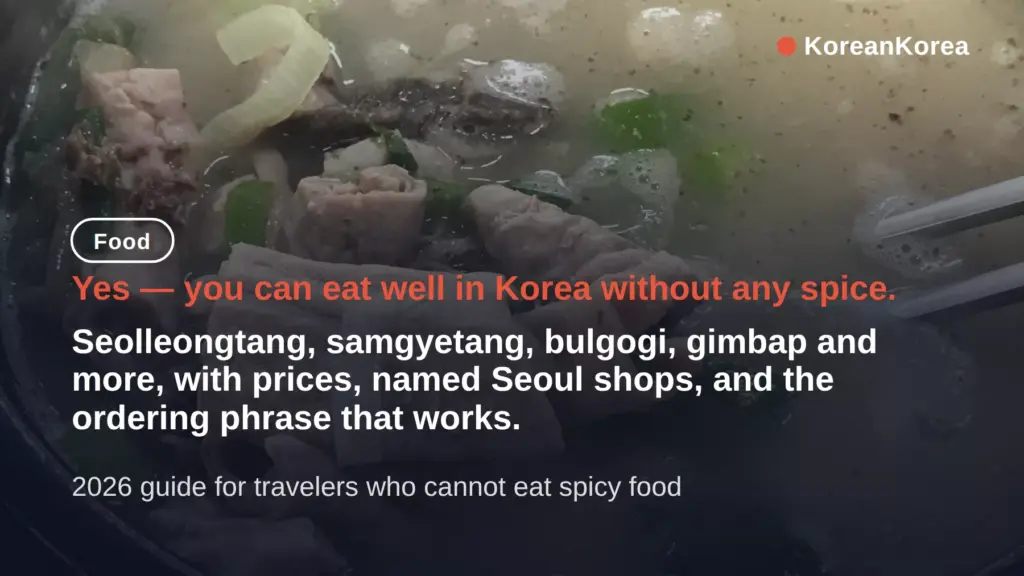
Yes — you can eat well in Korea without any spice: mild dishes like seolleongtang, samgyetang, bulgogi, and gimbap run about ₩8,000–15,000 per person on 2026 guide figures, and saying ‘an maepge’ (not spicy) when ordering is the key phrase.
Many of Korea’s signature dishes are sweet or sweet-savory rather than hot, so a spice-averse traveler is not stuck with convenience-store food.
This guide lists 10 safe dishes with prices, names the Seoul restaurants that serve them, and covers exactly what to say when the kimchi arrives.
What to Eat in Korea Not Spicy — Is Korean Food Spicy or Sweet?
| Seolleongtang | Milky beef-bone soup; broth unseasoned, you season it yourself at the table |
|---|---|
| Samgyetang | Whole young chicken stuffed with glutinous rice, ginseng, jujube; no chili in the broth |
| Bulgogi | Beef marinated in sweet soy sauce, sugar and pear, then grilled |
| Gimbap | Rice and mild fillings (carrot, pickled radish, egg) rolled in seaweed |
| Kalguksu | Knife-cut noodles in anchovy or chicken broth |
| Jjajangmyeon | Noodles in sweet-savory black bean sauce — no chili |
| Janchi guksu | Warm soy-sauce based noodles, no chili |
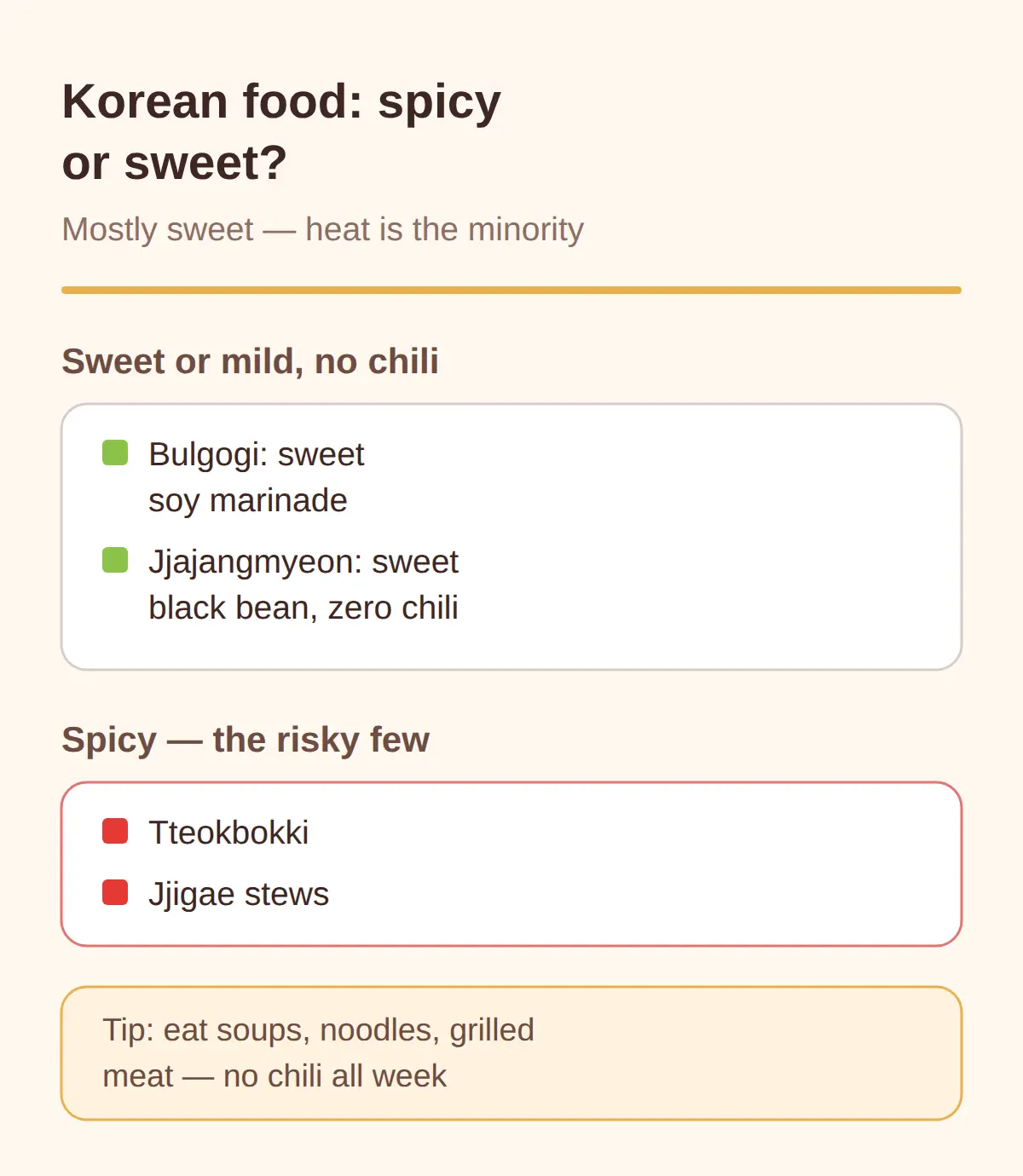
Most of Korea’s best-known dishes are sweet or sweet-savory, and the heat is concentrated in a minority of dishes like tteokbokki and jjigae stews.
Bulgogi is beef marinated in sweet soy sauce with sugar, pear and garlic.
Jjajangmyeon is a sweet-savory black bean sauce with no chili at all, and standard gimbap carries only mild fillings such as carrot, pickled radish, spinach and egg.
Google autocomplete shows year-round searches like ‘is korean food spicy or sweet’ and ‘is korean food spicy than indian food’, so if you are asking this, you are asking the same question thousands of travelers do before booking.
If your trip centers on soups, noodles and grilled meat, you can eat for a week without meeting a chili — the risk lives in stews and shared side dishes, not in most mains.
What Can I Eat in Korea If I Can’t Eat Spicy Food? The 10 Mild Dishes
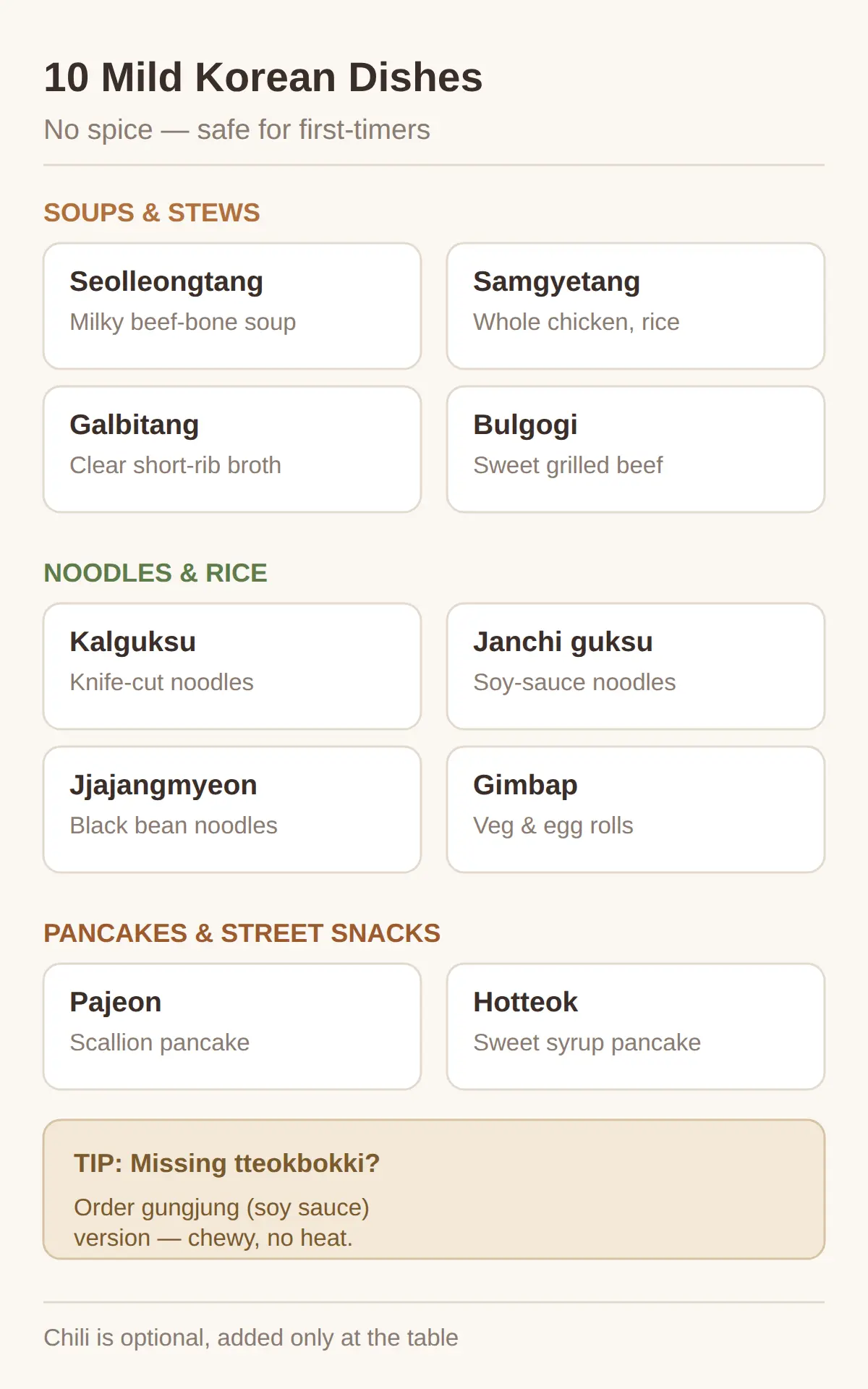
Ten dishes cover every situation from sit-down dinner to street snack, and first-time-visitor guides repeatedly name the same list.
- Seolleongtang — milky beef-bone soup simmered for hours; the broth itself is unseasoned and chili is only added at the table if you ask for it.
- Samgyetang — a whole young chicken stuffed with glutinous rice, ginseng, jujube and garlic, boiled into a mild broth with no gochujang.
- Bulgogi — sweet-savory grilled beef, no heat anywhere in the marinade.
- Gimbap — standard rolls use carrot, pickled radish, spinach and egg; only kimchi or spicy squid fillings make it hot.
- Kalguksu — knife-cut noodles in anchovy or chicken broth, unless a kimchi-broth variant is ordered.
- Janchi guksu — warm soy-sauce based noodles repeatedly recommended for first-timers.
- Jjajangmyeon — the Korean-Chinese black bean noodle dish, sweet-savory and chili-free.
- Galbitang — clear short-rib beef broth, listed alongside seolleongtang in not-spicy guides.
- Pajeon — scallion pancake pan-fried without chili, works as a shared main or side.
- Hotteok — a griddled pancake filled with brown sugar syrup, cinnamon and nuts; Korea’s standard sweet street snack for fall and winter.
If you want tteokbokki’s chewy rice cakes without heat, order the soy-sauce based gungjung (royal court) version instead of the spicy default.
How Much Does a Mild Meal Cost in Korea?
A mild Korean meal — seolleongtang, kalguksu, or gimbap — runs roughly ₩8,000–15,000 (about $6–11) per person on 2026 guide figures.
| Dish | Typical price (2026) |
|---|---|
| General mild meal (seolleongtang, kalguksu, gimbap) | ₩8,000–15,000 (about $6–11) per person |
| One gimbap roll at markets and snack shops | ₩3,500–5,000 (tuna or cheese versions higher) |
| Jjajangmyeon at Korean-Chinese restaurants | around ₩7,000–8,000 — one of the cheapest mild sit-down meals |
| Samgyetang at famous Seoul shops (Tosokchon, Hadongkwan) | around ₩17,000–20,000 per serving |
Markets and neighborhood restaurants are cheaper than tourist areas.
These ranges are guide-book approximations from secondary sources, not official price lists.
Exact per-dish prices at the named shops could not be confirmed from primary pages within the last six months, so treat every figure as approximate and check the board or menu photo before you order.
Budget roughly ₩10,000 per mild meal and you will rarely be short; for a splurge bowl, the samgyetang houses are the ones worth it.
Where to Eat Mild Food in Seoul: Named Shops
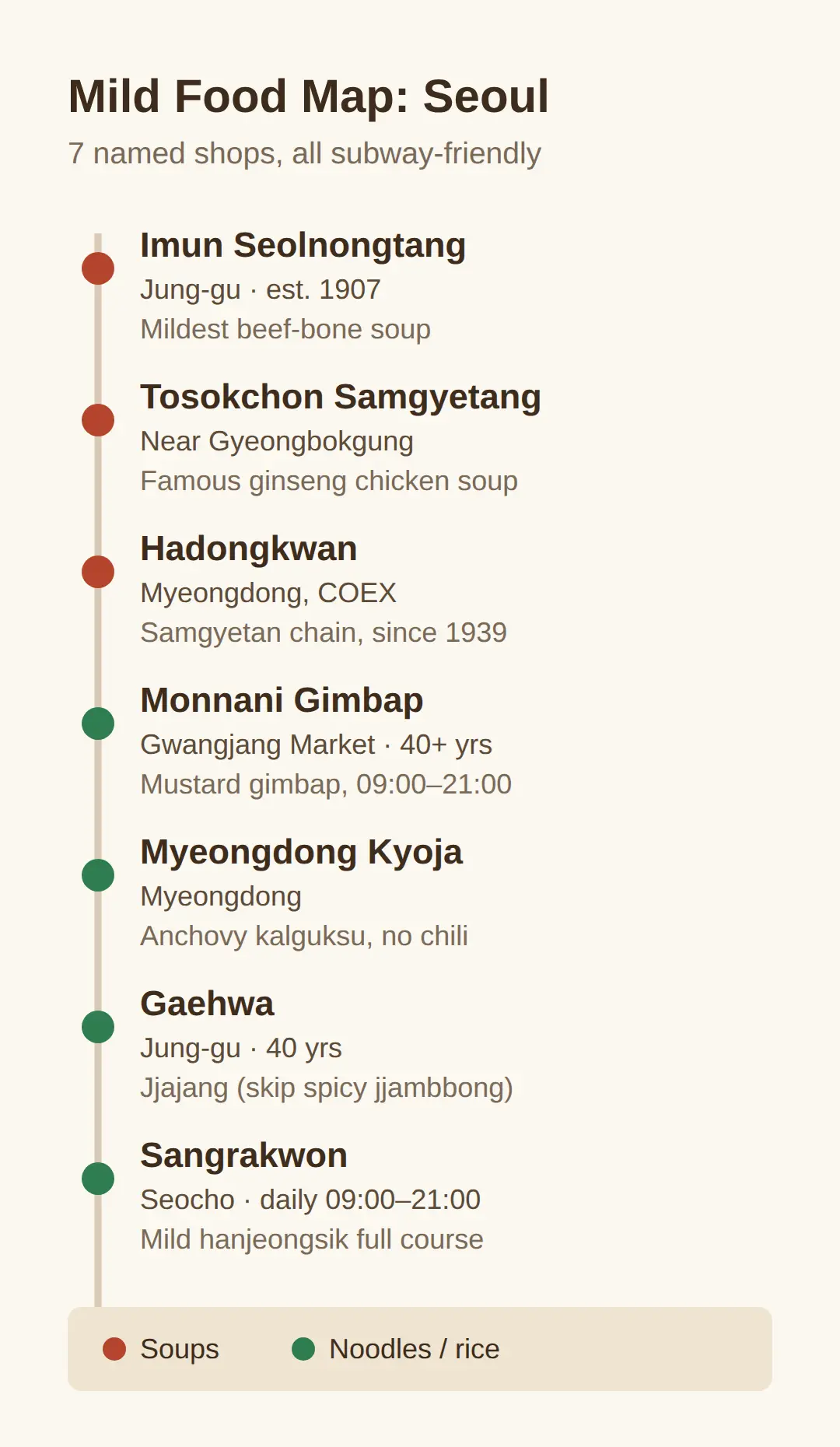
Seoul has a proven mild-dish circuit, from a 1907 soup house to a 40-year gimbap stall, and all of them are subway-accessible.
Imun Seolnongtang in Jung-gu is often cited as Seoul’s oldest operating restaurant (est.
- and specializes in the mildest beef-bone soup there is.
Tosokchon Samgyetang near Gyeongbokgung is the famous samgyetan house most tourists find first.
Hadongkwan, a samgyetan chain dating to 1939 in Gwangju, has Seoul branches in Myeongdong and COEX.
Monnani Gimbap in Gwangjang Market is a 40-plus-year-old shop credited as the original mustard-sauce gimbap — only carrot and pickled radish fillings, dipped in mustard sauce, open daily 09:00–21:00 and closed on public holidays, with two shops inside the market (1st: 403-23 Dongho-ro, Jongno-gu, 02-2273-8330, 99m from Exit 7 of Jongno 5-ga Station).
For noodles, Myeongdong Kyoja near Myeongdong runs a famously tiny four-item menu built on anchovy-broth kalguksu with no chili.
Gaehwa (02-776-0508, 52-5 Namdaemun-ro, Jung-gu) is a 40-year three-generation Chinese restaurant where the jjajang is hand-pulled noodles with potato, onion, carrot and pork — ask for ganjjajang if you want the dry version, and note that jjambbong, its other signature, is spicy.
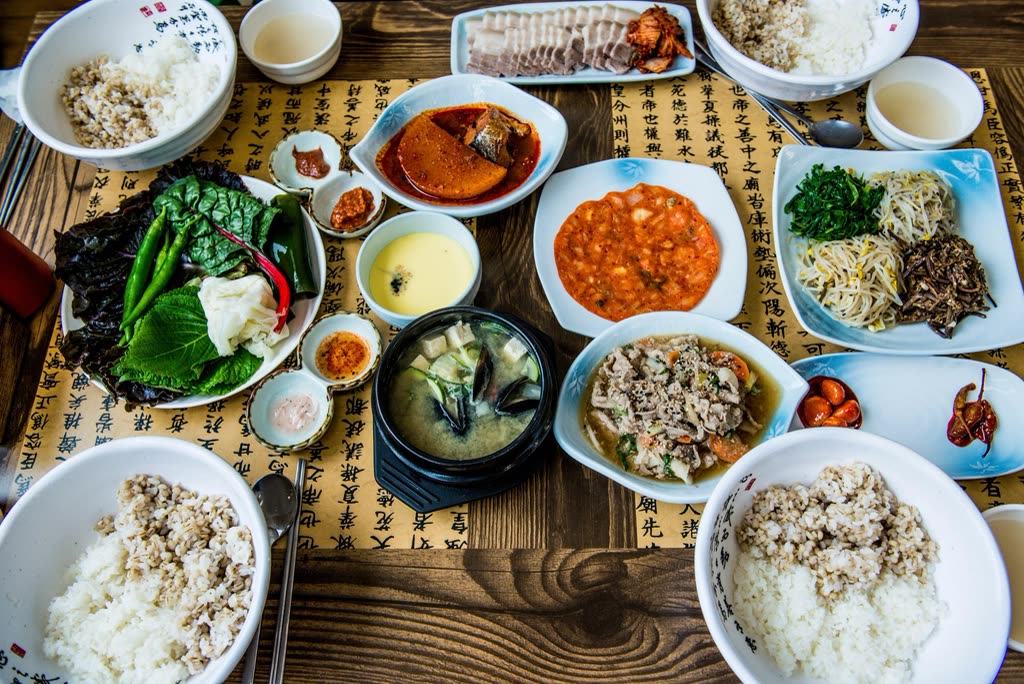
Sangrakwon in Seocho (0507-1329-5220, 23 Wonteo-gil, near Cheonggyesan Entrance Station, open daily 09:00–21:00, closed on holidays) serves a mild hanjeongsik full-course of stone-pot rice, grilled fish and many small side dishes.
If I were taking a spice-averse friend around Seoul, I would start at Imun Seolnongtang — seolleongtang is the one dish where nothing is spicy unless you put it there yourself, and the restaurant has been proving that since 1907.
Opening hours for several of these shops (Hadongkwan, Tosokchon, Imun, Myeongdong Kyoja) could not be re-verified from official sources for 2026 — check the shop’s page or Naver Map the morning you go.
How to Order Food That Isn’t Spicy
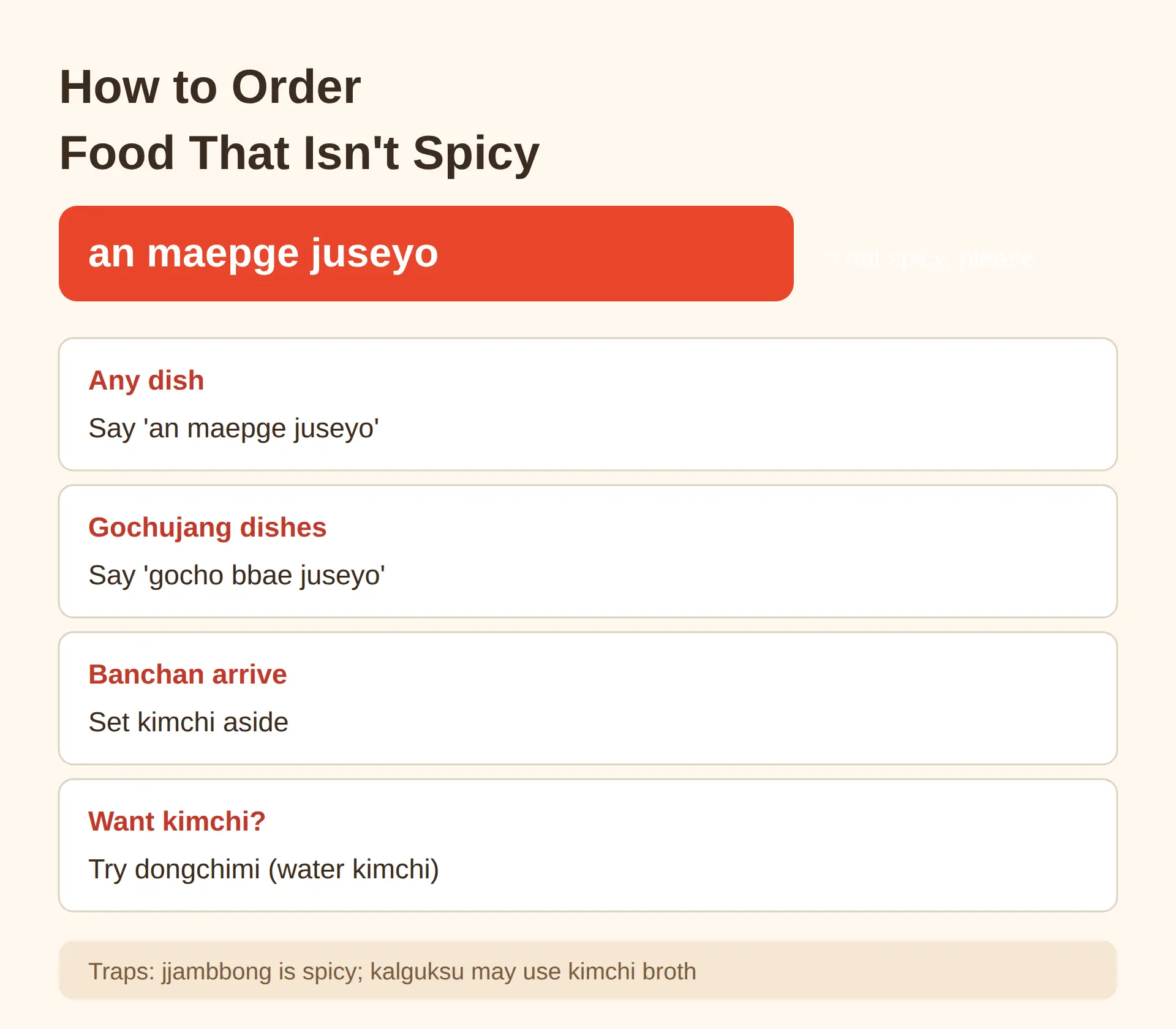
The phrase that works is ‘an maepge’ (not spicy) — say it when you order and guides list it as the key move for spice-averse travelers.
| Situation | What to say or do |
|---|---|
| Ordering any dish | Say ‘an maepge juseyo’ — most kitchens can adjust or will point you to the mild menu |
| Dishes built around gochujang (e.g. bibimbap) | Say ‘gocho bbae juseyo’ (please hold the chili) |
| When banchan (shared side dishes) arrive | Expect kimchi among them — simply set it aside, because the rest of your dish stays mild |
| Want to try kimchi anyway | Choose dongchimi (water kimchi), a clear radish version made without chili powder |
The spice usually hides in the shared side dishes, not your main — kimchi and some banchan arrive automatically, so setting them aside is the whole job.
Two lookalike traps: jjambbong is spicy even at a mild jjajangmyeon shop, and kalguksu can come in a kimchi-broth variant, so check which broth you are ordering.
Mild Options With a Catch: Seasonal and Tricky Dishes
Several mild dishes are safe only under a condition, and knowing the condition keeps you off the wrong order.
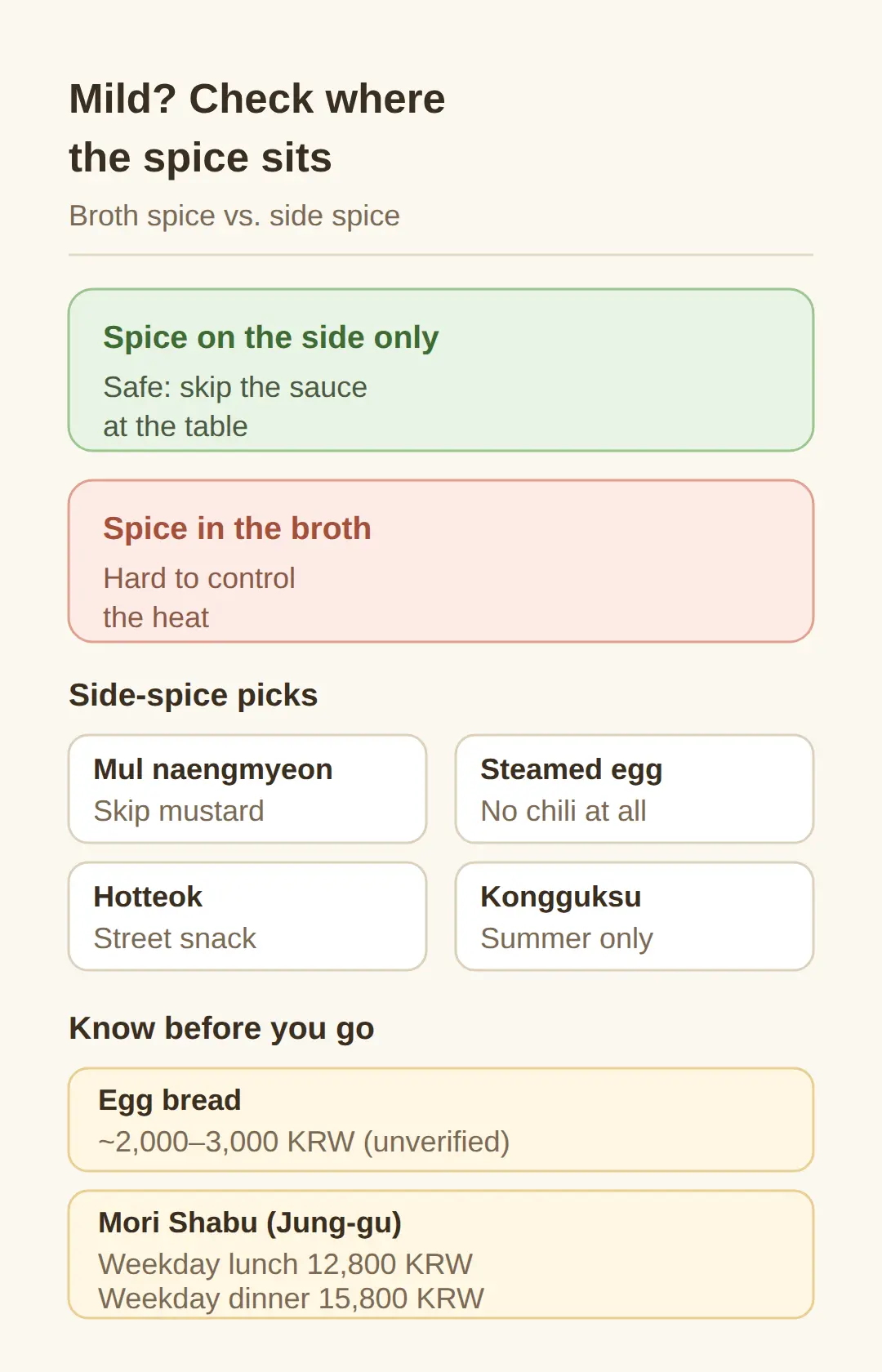
Mul naengmyeon is served in a mild iced broth — the spicy element is only the mustard and vinegar added at the table, so leave them out and it stays mild.
Steamed egg (gyeranjjim) is a soft custard with no chili, served as a side at most Korean restaurants.
Hotteok and egg bread (gyeran-bbang) are sweet-savory street snacks with no spice, though I could not confirm their current prices from the sources available.
Kongguksu, a cold noodle soup in ground soybean broth, is a summer dish — fall travelers should confirm it is still on the menu before counting on it.
If I look at any Korean dish, the first thing I check is whether the spice arrives in the broth itself or only on the side — broth-based dishes are the safest category, because you control the heat at the table.
One fixed-price option that removes all guessing: Mori Shabu Cheonggye in Jung-gu serves a beef and mushroom shabu-shabu with a 70-item salad bar at ₩12,800 weekday lunch and ₩15,800 weekday dinner, per its listing on a Korean restaurant-review site.
Related posts
📎 Seoul — everything we know
📎 📅 다가오는 일정 — 발매·개봉·발표 캘린더
Sources
- Street snack level pricing ~2,000–3,000 KRW (secondary sourc (coreadesk.com)
- Mild meal 8,000 KRW+, gimbap 3,500–5,000 KRW, ‘an maepge’ ph (exploretripsguide.com)
- Whole chicken soup, salt-dip on side, broth not spicy (korean.visitseoul.net)
Your One-Glance Pick by Situation
- Cannot eat any spice at all → seolleongtang or samgyetang; the broth is unseasoned and you control everything at the table.
- Want the classics without heat → bulgogi and standard gimbap are already mild; for tteokbokki, order gungjung (soy-sauce) style.
- Worried about side dishes → kimchi arrives automatically; set it aside, or say ‘an maepge’ when ordering.
- Want to taste many dishes at once, chili-free → book a hanjeongsik such as Sangrakwon in Seocho.
- Want a cheap mild meal or a street snack → jjajangmyeon (about ₩7,000–8,000) or hotteok from a street stall; skip egg bread if you want only confirmed prices.
FAQ
Q. Is Korean food spicy or sweet?
Mostly sweet or sweet-savory. Bulgogi, jjajangmyeon, gimbap and hotteok carry no heat; the heat is concentrated in a minority of dishes such as tteokbokki and jjigae stews.
Q. What can I eat in Korea if I can’t eat spicy food?
Seolleongtang, samgyetang, bulgogi, gimbap, kalguksu, janchi guksu, jjajangmyeon, galbitang, pajeon and hotteok are all mild, and ‘an maepge’ (not spicy) is the phrase to use when ordering.
Q. How much does a non-spicy meal cost in Korea?
Guides put a mild meal at roughly ₩8,000–15,000 per person on 2026 figures. A gimbap roll is about ₩3,500–5,000, and famous-shop samgyetang runs higher, around ₩17,000–20,000 — treat all as approximate.
Q. How do I ask for food without spice in Korean?
Say ‘an maepge juseyo’ (not spicy, please) when ordering. For gochujang-based dishes, ‘gocho bbae juseyo’ asks them to leave out the chili.
Q. Is kimchi always spicy?
The standard cabbage kimchi is, but dongchimi — water kimchi made with clear radish and no chili powder — is the usual mild alternative.
Prices move and hours change — re-check the shop’s Naver Map listing the morning you go, and keep ₩15,000 per meal as your planning number.
Cover photo: Naejang-gomtang 1 by lazy fri13th — CC BY 2.0
#Koreanfood #notspicyKoreanfood #seolleongtang #samgyetang #Koreatravel2026 #mildKoreandishes #Seoulrestaurants
📅Upcoming Schedule — this week 23 · D-1 Autumn season = post-summer brightening demand window (UV drSee all →