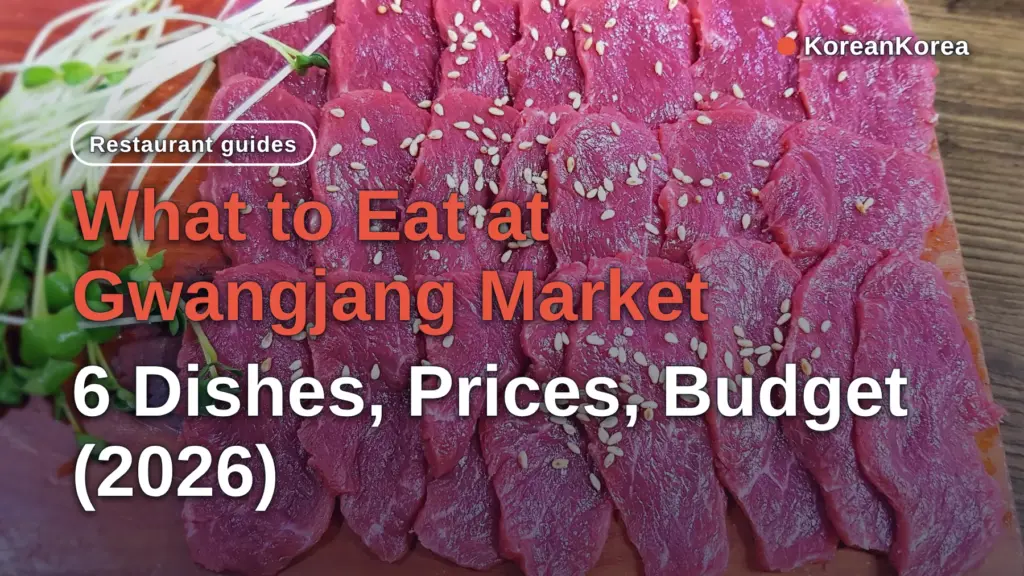
At Gwangjang Market in Seoul, one person eats well on ₩15,000–₩25,000, and the classic plate is bindaetteok with mayak gimbap and a drink.
That means a first evening there does not need a restaurant reservation, a big budget or any Korean — the whole meal happens standing at a few stalls.
This post lists six dishes with prices and spice levels, three budget levels per person, how to get there, what to order if you cannot eat spicy food, and the small things that trip visitors up.
Key facts — As of 2026-10-01
- A single bindaetteok costs 5,000-6,000 won according to one 2026 guide, with another 2026 guide putting the range at 5,000-7,000 won.
- Per 2026 budget estimates, a standard Gwangjang course of bindaetteok plus mayak gimbap plus a drink runs 20,000-25,000 won, while yukhoe with drinks runs 30,000-50,000 won per person.
- A bottle of makgeolli to pair with bindaetteok at the stalls is 4,000-5,000 won as of the 2026 guides.
What To Eat At Gwangjang Market And What Each Dish Costs
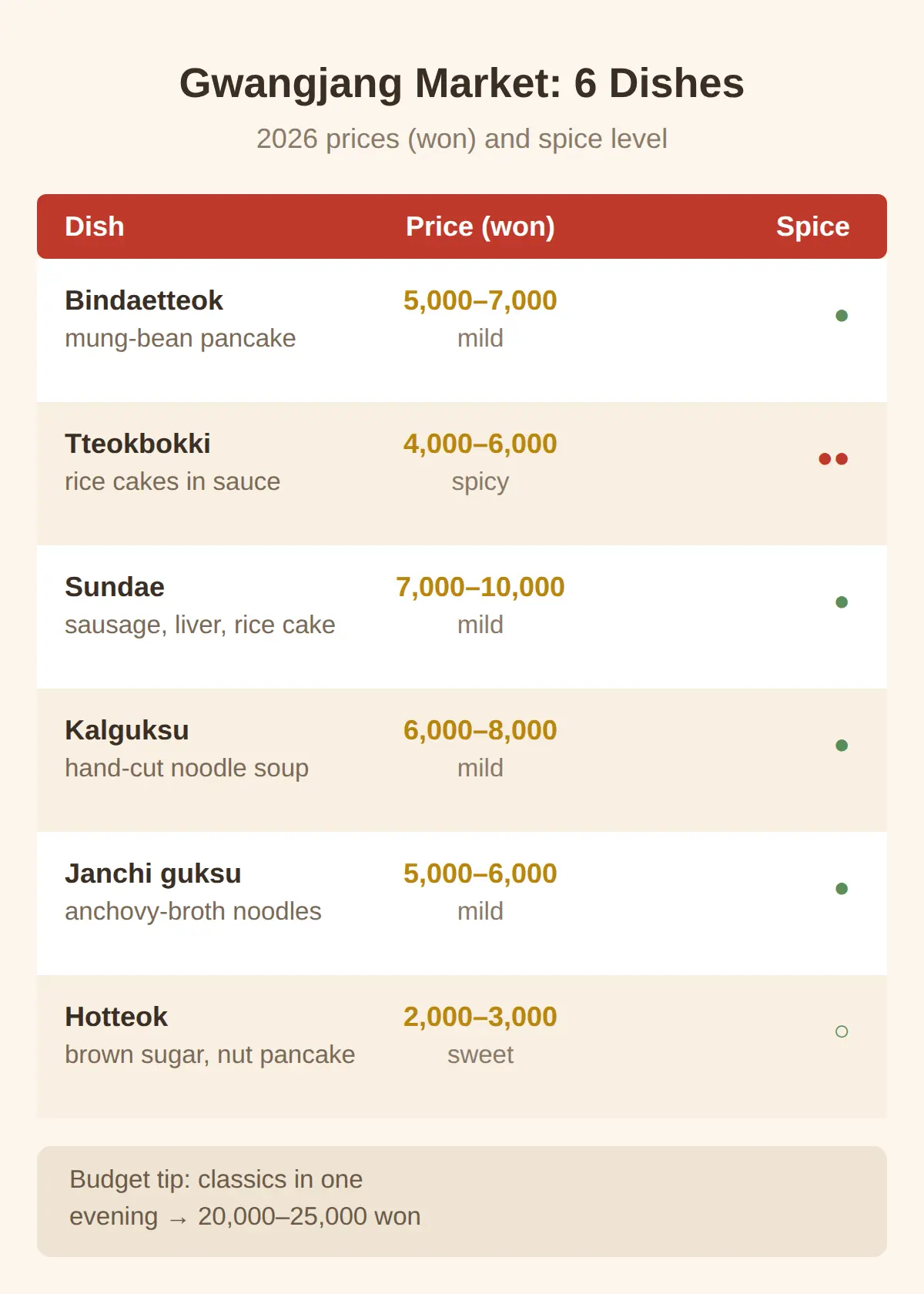
Six dishes cover a first visit, and the table below gathers the prices and spice levels from 2026 visitor guides.
| Dish | Price | Spice level |
|---|---|---|
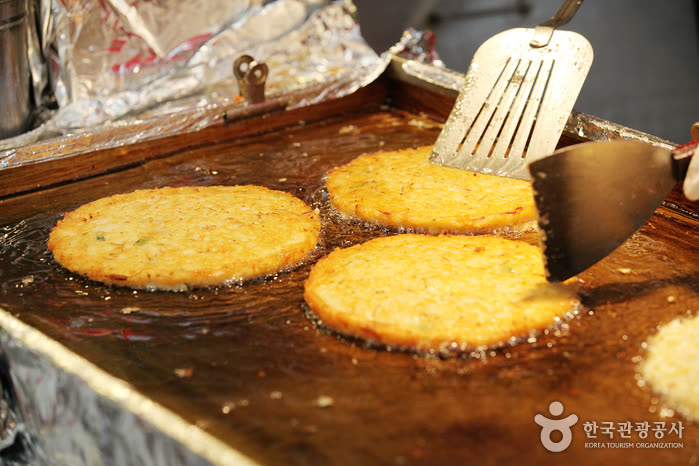
| Bindaetteok (mung-bean pancake) | 5,000–7,000 won | Mild |
| Tteokbokki | 4,000–6,000 won | Spicy |
| Sundae (sausage with liver and rice cakes) | 7,000–10,000 won | Mild |
| Kalguksu (hand-cut noodle soup) | 6,000–8,000 won | Mild |
| Janchi guksu (anchovy-broth noodle bowl) | 5,000–6,000 won | Mild |
| Hotteok (brown sugar and nut pancake) | 2,000–3,000 won | Sweet |
The bindaetteok range differs by guide — one 2026 guide puts a single pancake at 5,000–6,000 won, another at 5,000–7,000 won — so treat both as a ballpark rather than a fixed price.
Mayak gimbap has no confirmed price in recent guides, so ask at the stall before ordering.
Each food sits in its own row of the market: bindaetteok stalls line the alley nearest Exit 7, mayak gimbap stalls sit mid-market, and about five yukhoe (raw beef) stalls cluster near Exit 8.
Hotteok and dessert stands are scattered near the entrances, and the tteokbokki and sundae corner is on the east side near the hanbok shops.
If you want to cover the classics in one walk, start at Exit 7, work toward the mid-market gimbap row, and finish at Exit 8.
| Bindaetteok (mung-bean pancake) | 5,000–7,000 (one 2026 guide: 5,000–6,000) |
|---|---|
| Mayak gimbap (sesame-oil rice rolls) | Recent price not listed — ask at the stall |
| Tteokbokki (soft rice cakes in sauce) | 4,000–6,000 |
| Sundae (Korean sausage with liver) | 7,000–10,000 |
| Kalguksu (hand-cut noodle soup) | 6,000–8,000 |
| Hotteok (brown-sugar pancake) | 2,000–3,000 |
How Much Should I Budget For One Person
Three budgets cover every kind of visit: a light snack of 3–4 items runs about ₩15,000, the standard course of bindaetteok plus mayak gimbap plus a drink runs ₩20,000–₩25,000, and yukhoe with drinks runs ₩30,000–₩50,000 per person.
The standard course rises again if you add makgeolli, which is ₩4,000–₩5,000 a bottle at the bindaetteok stalls.
The snack figure only works if you actually order 3–4 items — a single chapssal doughnut at ₩1,500–₩2,000 falls far short of ₩15,000, so two items do not add up to it.
Budget pieces you can mix: assorted jeon plates ₩3,000–₩5,000 each, haemul pajeon ₩10,000–₩14,000, janchi guksu ₩5,000–₩6,000.
Pajeon costs roughly twice a plate of assorted jeon (₩10,000–₩14,000 against ₩3,000–₩5,000), so order jeon if you are watching the bill.
Some older stalls are cash-only, so carry ₩20,000–₩50,000 in small bills.
Getting There And What Hours To Go
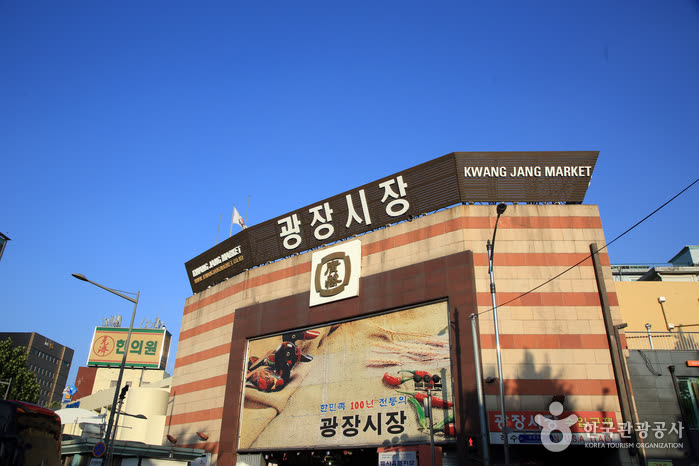
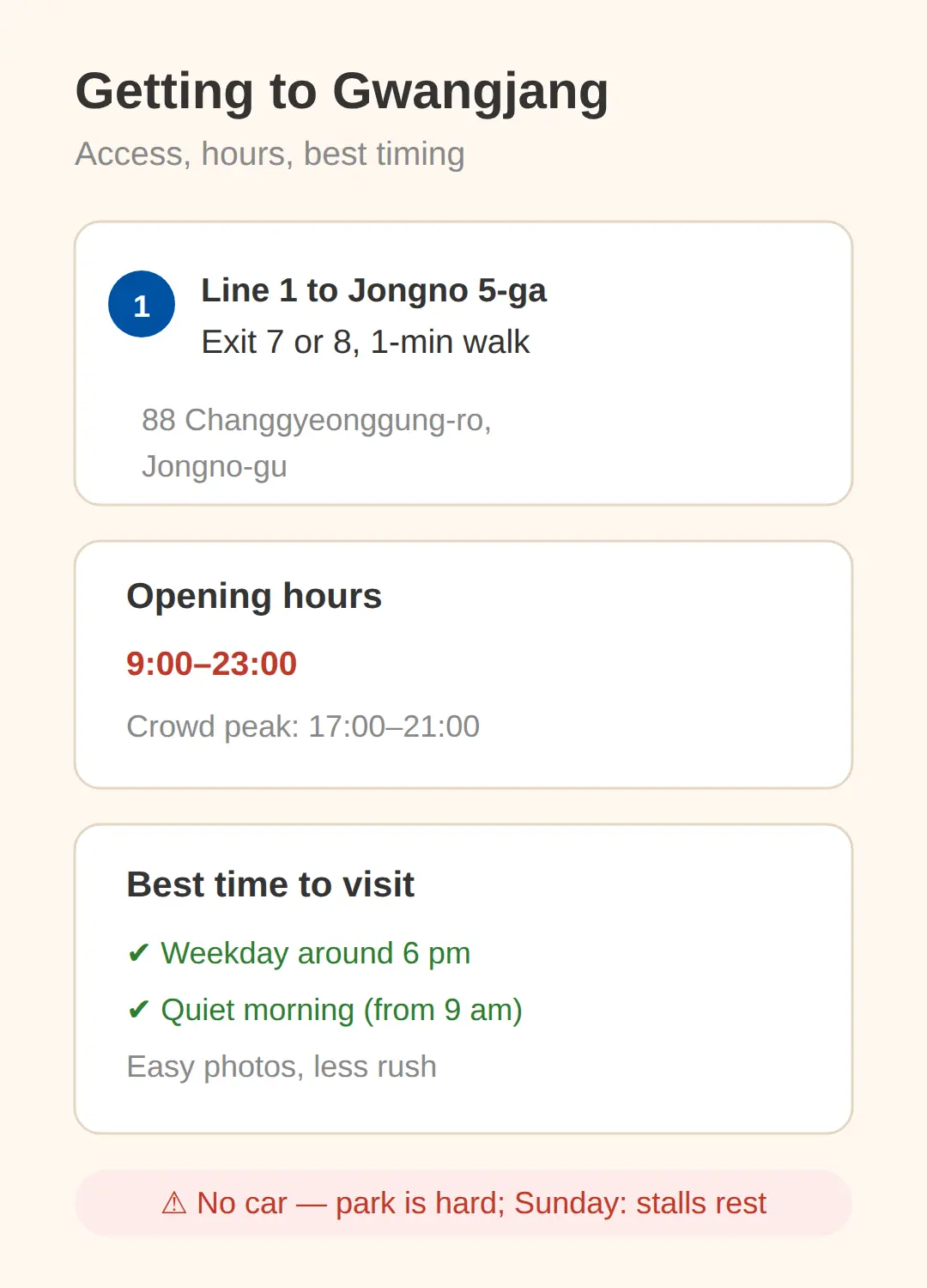
Take Line 1 to Jongno 5-ga Station and leave by Exit 7 or 8; the market entrance is a 1-minute walk, at 88 Changgyeonggung-ro, Jongno-gu.
Most food stalls run 9:00–23:00, with the crowd peaking between 17:00 and 21:00.
Go Monday through Saturday — Sundays are quieter and some stalls rest, and which weekday is the real partial-closure day differs across guides, so confirm on site.
Driving is not recommended because Jongno parking is difficult; the subway stop is the easy way in.
If it were me, I would go on a weekday around 6 pm or in the quiet morning — the market opens from around 9 am, and a morning visit also makes photos much easier than the 5–9 pm rush.
Ordering If You Cannot Eat Spicy Food Or Are Vegetarian
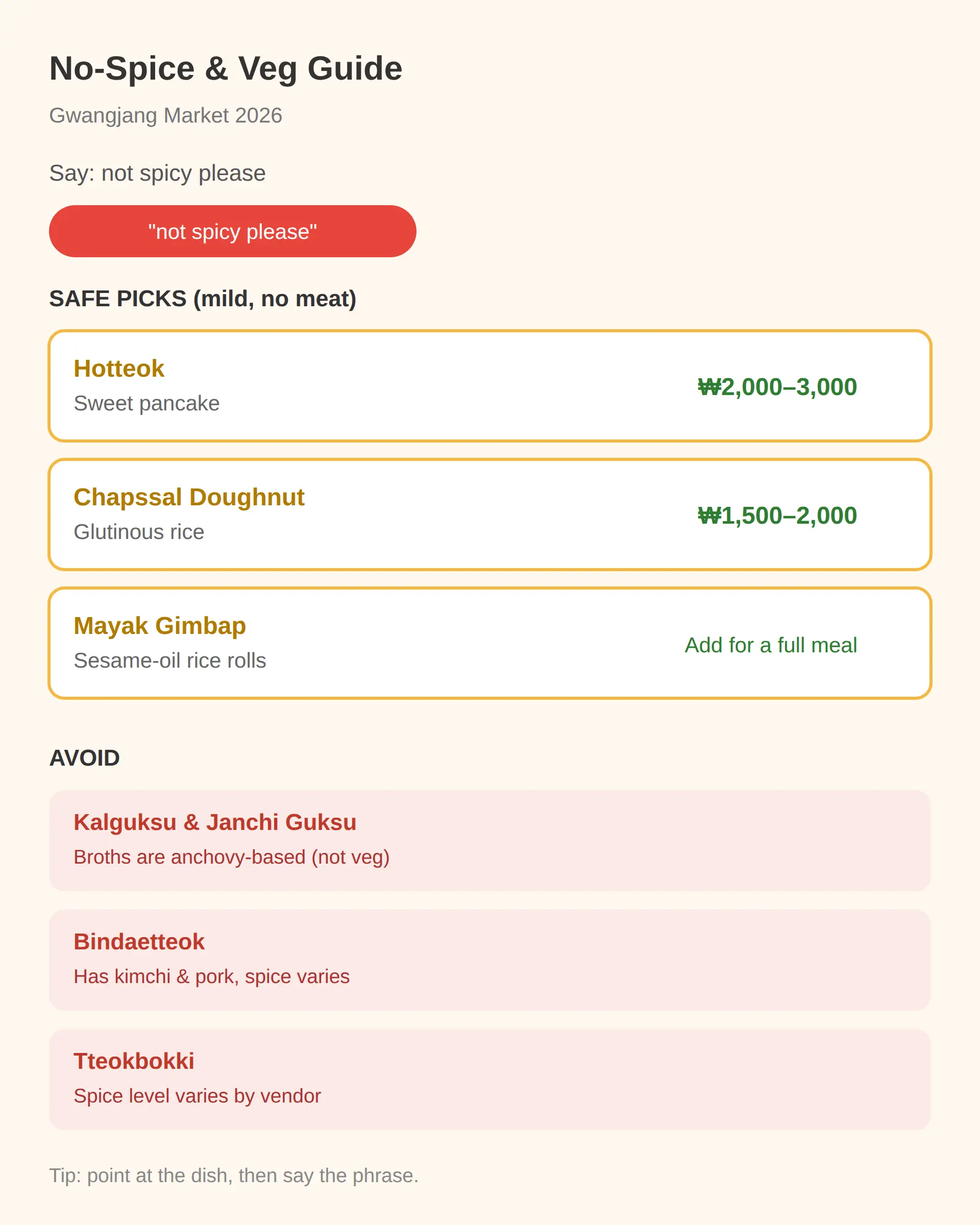
Ask for each dish with the phrase ‘not spicy please’ (an mapge haejuseyo), and the two safest no-spice picks are hotteok (₩2,000–₩3,000) and the chapssal glutinous-rice doughnut (₩1,500–₩2,000).
Spice levels vary by vendor, so the same tteokbokki can come mild at one stall and hot at the next — there is no standard level across the market.
The noodle soups are the catch for vegetarians: kalguksu and janchi guksu broths are anchovy-based, so skip both.
Bindaetteok contains kimchi and pork in the batter, so it is mild rather than non-spicy and not vegetarian.
If you cannot eat spicy food at all, build the meal from the two desserts plus mayak gimbap, and point at the dish before saying the phrase if your Korean is thin.
Paying, Seating And Small Things That Trip Visitors Up
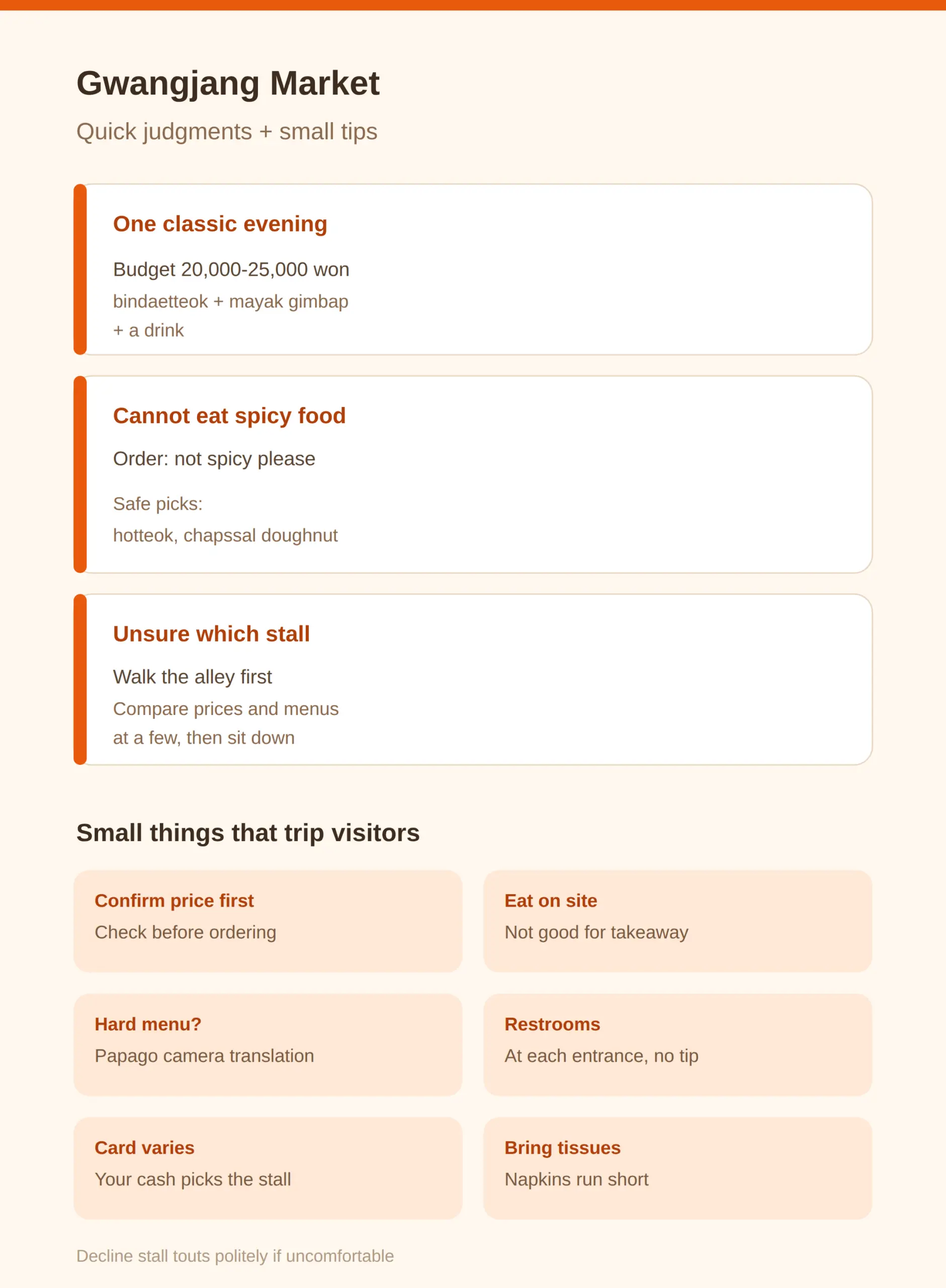
Confirm the price before ordering, and politely decline stall touts at the entrance if you feel uncomfortable — overcharging visitors is rare but worth the check.
Eat on site, because the food does not suit takeaway, and bring your own tissues since napkin portions at stalls are small.
Menus that are hard to read are covered by Papago’s camera translation.
Public shared restrooms sit at each market entrance, and no tip is expected at any stall.
Card acceptance varies by vendor, so the cash in your pocket decides which stalls you can sit at.
If you stand in front of several stalls unsure which to pick, walk the alley comparing prices and menus at a few before sitting down — the food is broadly good at any of them.
The Market Itself In One Minute — And What Else Is Upstairs
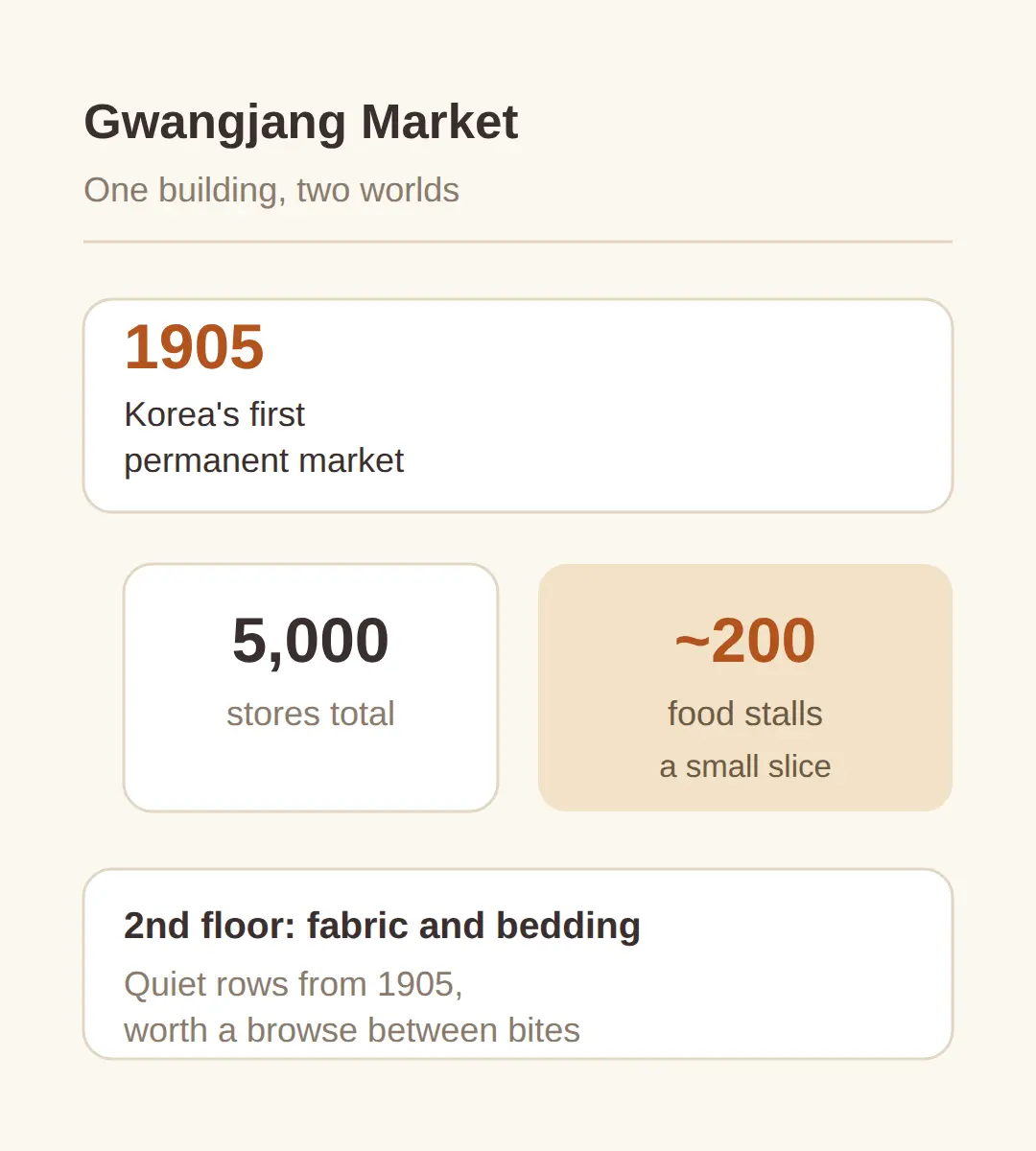
Gwangjang opened in 1905 as Korea’s first permanent market, starting as a hanbok and fabric market.
About 5,000 stores operate in the building, of which roughly 200 are food stalls, so the food rows are a small slice of a working market.
The 2nd-floor fabric and bedding shops still carry the market’s 1905 origins, and they are quiet enough to be worth a quick browse between food stops.
If your legs need a break between the bindaetteok alley and the yukhoe corner, the upstairs fabric rows are the place to spend it.
Related posts
📎 Seoul — everything we know
📎 📅 Upcoming Dates — Release & Event Calendar
Sources
- Anchovy broth for noodles; hotteok/chapssal donut vegetarian (koreabycar.com)
- Gwangjang named best street-food neighborhood; snacks 2,000- (koreaunlocked.com)
- Market snack list with spice-level note (coreadesk.com)
Quick Summary
- Light snack of 3–4 items: about ₩15,000 · standard course (bindaetteok + mayak gimbap + a drink): ₩20,000–₩25,000 · yukhoe with drinks: ₩30,000–₩50,000.
- Bindaetteok alley: Exit 7 side · mayak gimbap: mid-market · yukhoe stalls: Exit 8 side.
- Go Monday–Saturday, 9:00–23:00 stall hours; a weekday around 6 pm or a quiet morning beats the 17:00–21:00 peak.
- Cannot eat spicy food: say ‘not spicy please’ (an mapge haejuseyo); safe picks are hotteok and the chapssal doughnut.
- Carry ₩20,000–₩50,000 in small bills and skip driving — Jongno parking is difficult.
FAQ
Q. What should I eat at Gwangjang Market?
Start with bindaetteok (mung-bean pancake, ₩5,000–₩7,000) and mayak gimbap, then add tteokbokki (₩4,000–₩6,000), sundae (₩7,000–₩10,000) or kalguksu (₩6,000–₩8,000) depending on your appetite.
Q. How much does a meal at Gwangjang Market cost per person?
A light snack of 3–4 items runs about ₩15,000, the standard course of bindaetteok plus mayak gimbap plus a drink runs ₩20,000–₩25,000, and yukhoe with drinks runs ₩30,000–₩50,000 per person (2026 guides).
Q. Where in the market do I find bindaetteok, mayak gimbap and yukhoe?
Bindaetteok stalls line the alley nearest Exit 7, mayak gimbap stalls sit mid-market, and about five yukhoe stalls cluster near Exit 8.
Q. Can I eat at Gwangjang Market if I cannot eat spicy food or I am vegetarian?
Yes — order with ‘not spicy please’ (an mapge haejuseyo), and pick hotteok (₩2,000–₩3,000) and the chapssal doughnut (₩1,500–₩2,000); vegetarians should skip kalguksu and janchi guksu because the broths are anchovy-based.
Q. Do Gwangjang Market stalls take cards?
Card acceptance varies by vendor and some older stalls are cash-only, so carry ₩20,000–₩50,000 in small bills.
Check the 2026 guides linked above for current stall rows before your visit, and confirm the day’s closure situation on site.
Cover photo: Korean beef Sashimi by Trainholic — CC BY-SA 3.0
#gwangjangmarket #seoulstreetfood #whattoeatinseoul #koreanmarketfood #seoulfoodguide
📅Upcoming Schedule — this week 1 · D-7 Godsoi lineup removed from menus after 2026-11-09See all →Last updated 2026-10-27. Editorial policy