You can order Korean street food at a market in 5 steps: confirm the unit, the quantity, the add-ons, and card acceptance before cooking, then watch for the vendor’s cue.
For a visitor, that means five short phrases cover the whole purchase — but ‘not spicy’ only works on dishes cooked to order, not on tteokbokki from a shared pot.
This post walks through the 5-step method, the phrases, payment, stall hours, and what to do when speech fails.
Key facts — As of 2026-10-02
- Daytime market food stalls typically open around 13:00 and close 18:00–19:00; night-market stalls run to about 21:00 — a general pattern, not a per-market fact.
How to Order Korean Street Food at a Market: The 5-Step Flow
| You want a made-to-order item (grilled, fried per order) | Say ‘An maeppge haejuseyo’ — the request works |
|---|---|
| You want tteokbokki or another batch-pot dish | Don’t ask for mild — ask ‘is it spicy?’ before ordering |
| You can’t say the item name in Korean | Point at the display tray, hold up fingers, say ‘Igeo juseyo’ |
| You want to pay by card | Ask whether card is accepted BEFORE the food is made |
| You’re unsure whether ‘1’ means one stick or one serving | Confirm the unit first — skewers per piece, tteokbokki per portion |
| You plan to pay cash | Carry small bills (₩5,000–10,000 notes) |
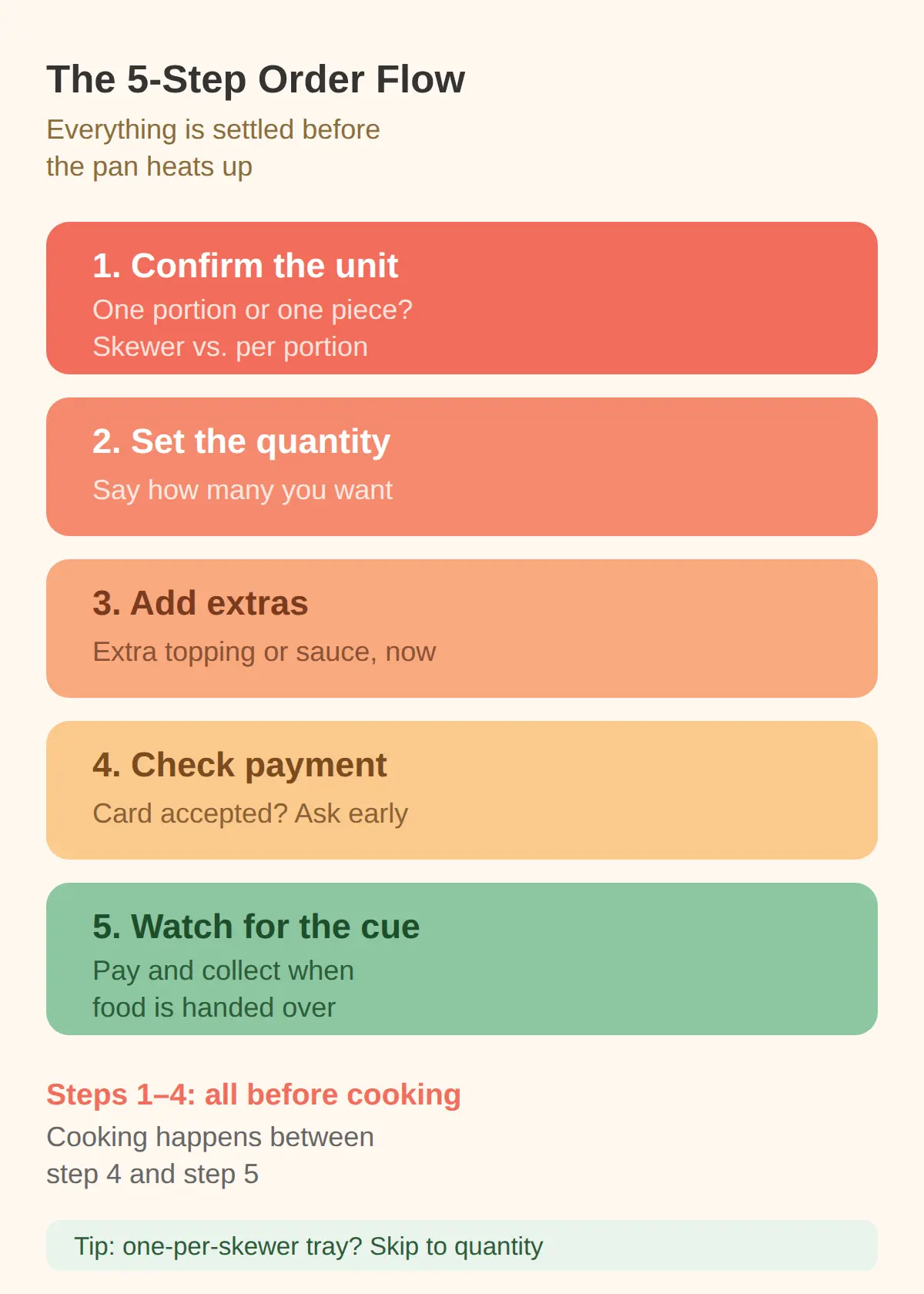
The order runs in 5 steps, and the first four all happen before the food is cooked.
Guides aimed at first-time visitors describe the same flow: confirm the unit, the quantity, the extras, and the payment method, then wait for the vendor’s cue.
If you only remember the sequence, remember this: everything gets settled before the pan heats up.
- Confirm the unit — ask whether ‘one’ means one portion or one piece, because skewers are counted per stick while tteokbokki and fried foods are counted per portion (‘1 inbun’).
- Set the quantity — say how many you want once the unit is clear.
- Add extras — ask for extra topping or sauce on the spot if you want it.
- Check payment — ask whether card is accepted before cooking starts.
- Watch for the vendor’s cue — pay and collect when the food is handed over.
Asking ‘Il-inbun-ieyo?’ (one portion?) covers step 1, though the phrase comes from a single ordering guide rather than a settled standard.
Vendors count units differently by item, so a confirmed unit prevents a double order.
If the item is clearly one-per-skewer on the display tray, you can skip straight to quantity.
When Does ‘Not Spicy’ Work — and When It Won’t
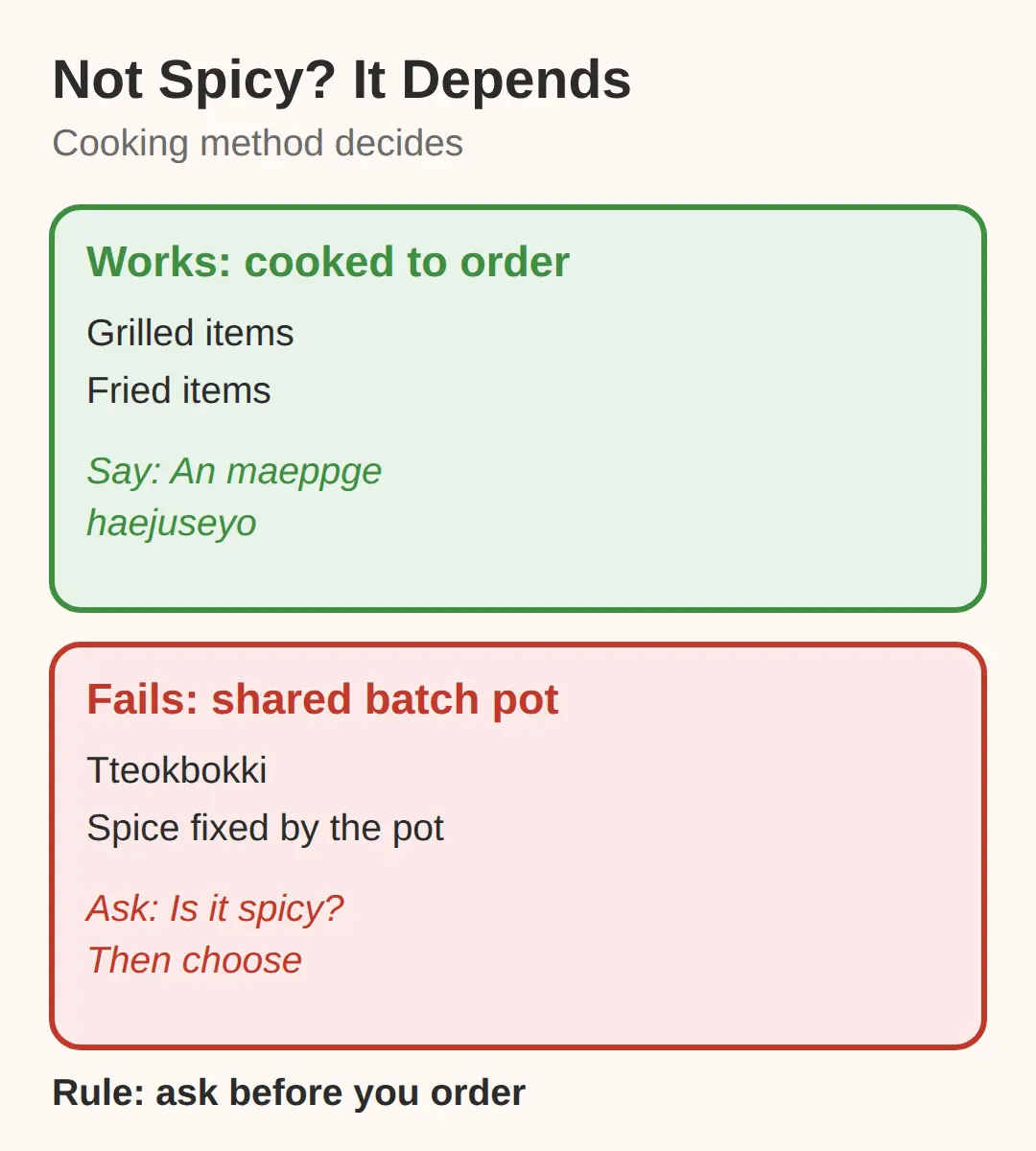
‘An maeppge haejuseyo’ (please make it not spicy) works on dishes cooked to order, and it does not work on dishes cooked in a shared batch pot.
The difference is how the dish is made, not how it looks.
Tteokbokki is the clearest example of the second kind: it sits in a shared pot, so the spice level is fixed by the pot and no per-order adjustment is possible.
Korean food guides for first-time visitors give the same instruction — ask whether a dish is spicy before ordering instead of judging by appearance.
Some dishes can be adjusted and batch-cooked ones cannot, so the question comes first either way.
If you want a grilled or fried item cooked per order, ‘An maeppge haejuseyo’ is the request to use.
If the item sits in a batch pot, ask ‘is it spicy?’ and choose after the answer.
When spice decides whether you can eat something at all, put the question before any order.
The Phrases That Cover a Market Order
Four phrases cover a standard market purchase, and one backup phrase handles the unit question.
Guides frame market ordering as learnable with one to five phrases, so a full set fits on a phone note.
| Phrase | Romanization + Korean | What it does | When it fails |
|---|---|---|---|
| Give me this one | Igeo juseyo | Orders what you point at on the display tray | Nothing — it is the standard fallback |
| Please make it not spicy | An maeppge haejuseyo | Requests a mild version | Batch-pot dishes like tteokbokki |
| Is card accepted? | Ask before the food is made | Sets the payment method early | Asked after cooking, some stalls refuse |
| One portion? | Il-inbun-ieyo? (1인분이에요?) | Confirms portion vs. piece | Vendors count some foods by the piece |
‘Hana juseyo’ appears in guides as the baseline phrase for one item, though it is the least situation-specific of the set.
If you keep only two, keep ‘Igeo juseyo’ with pointing and the card question.
Adding ‘An maeppge haejuseyo’ covers the spice question that trips up most first-time visitors.
Card or Cash at a Market Stall?
Ask about card acceptance before the food is made — that is the single payment rule at a market stall.
Some stalls cook first and then point you to a shared card terminal, or refuse cards once the food is already cooked.
Cards are increasingly accepted at small stalls and street carts, but cash in small bills remains the safe default.
Guides recommend carrying small bills, in the ₩5,000–10,000 range, because stall prices are low per item and some cash-only carts may not take large notes.
One note in that range usually covers a single-item order with manageable change.
Guides suggest this small-bill habit rather than documenting it from official sources, so treat it as practical advice, not a rule.
If you carry two small notes, you can complete any order whether the stall takes cards or not.
If you carry only a card, ask about payment in step 4 of the ordering flow and walk to another stall if the answer is no.
An ATM visit before a market trip removes the problem entirely.
When Are Stalls Open, and Where Do You Eat It?
Daytime market food stalls typically open around 13:00 and close between 18:00 and 19:00 — roughly a 5–6 hour window.
Night markets and evening stalls run later, to about 21:00 or beyond, which is around 2–3+ hours longer than the daytime window.
Treat both numbers as a general pattern: specific markets differ widely, and per-market hours are not confirmed here.
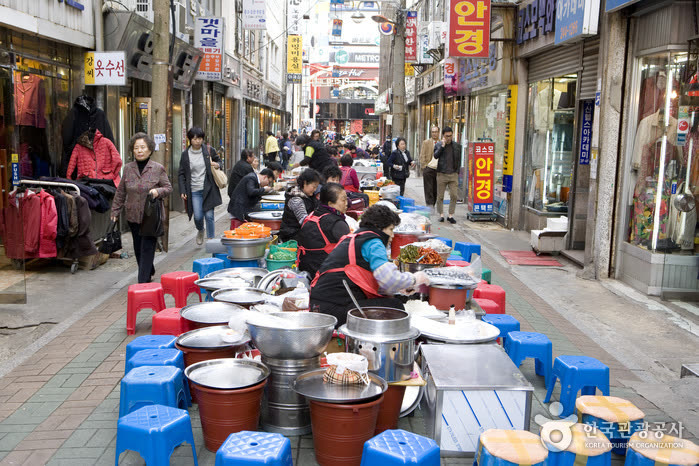
Most market stalls have no seating.
Food is eaten standing at the stall or while walking, so plan to finish before moving on to the next stall.
That eating style is the norm rather than an exception at traditional markets.
If you are building a market visit around food, aim for the afternoon-to-evening window rather than a morning one.
If you want the longest hours, a night market is the safer choice.
Plan to eat standing, and keep cash or a card ready while you wait.
If Words Fail: Pointing, Fingers, and Cash-Only Stalls
Pointing at the display tray and holding up fingers for quantity works when speech fails.
Vendors at market stalls are used to gestures, and ‘Igeo juseyo’ plus a pointed finger completes the order on its own.
This fallback is documented in visitor guides as a fully acceptable way to order.
The fallback covers the ordering problem but not the payment problem.
At a stall that stays cash-only, the practical fix is visiting an ATM beforehand and carrying small bills — guides recommend the ₩5,000–10,000 range for exactly this case.
Whether specific famous markets still have cash-only stalls needs on-site confirmation, so check the stall’s payment setup in step 4.
If it were me, I would lead with ‘Igeo juseyo’ plus a pointed finger at every stall, because gestures get understood faster than any phrase I might mispronounce.
I would also keep two or three ₩5,000–10,000 notes in a separate pocket, so a cash-only stall never forces a mid-market ATM hunt.
If you cannot say the item name, point first and let ‘Igeo juseyo’ carry the rest.
If the stall turns out to be cash-only, keep one small note from your pocket reserve for that purchase.
If neither works, the next stall is usually within sight.
Related posts
📎 📅 Upcoming Dates — Release & Event Calendar
Sources
- Card acceptance rising but cash recommended; confirm first ( (discoverrealkorea.com)
- Ask spiciness before ordering; some dishes can’t be adjusted (coreadesk.com)
- No dated price list found within 6 months (blog.firstage.ai)
The Market Order, in Short
- Settle unit, quantity, add-ons, and card acceptance before the food is cooked — that is the whole 5-step flow.
- Ask ‘Is it spicy?’ first, because ‘not spicy’ requests only work on made-to-order items, never on shared-batch pots.
- Carry small bills (₩5,000–10,000) even if you plan to pay by card.
- Point at the display tray and hold up fingers when the item name fails you.
- Expect no seating — eat standing or walking, and finish before moving on.
FAQ
Q. How do I order Korean street food if I don’t speak Korean?
Point at the display tray, hold up fingers for quantity, and say ‘Igeo juseyo’ (give me this one). Vendors are used to gestures, and that completes the order without speech.
Q. Why does ‘not spicy’ fail at some stalls?
Because the dish is cooked in a shared batch pot. Tteokbokki is the common example — the spice level is fixed by the pot, so a per-order mild request cannot be honored. Ask ‘is it spicy?’ before ordering instead.
Q. Which popular dishes can’t be made mild?
Dishes cooked in a shared batch pot — tteokbokki is the one guides name most. Made-to-order grilled or fried items are the ones where a mild request can work.
Q. Should I ask about card payment before or after the food is made?
Before. Some stalls cook first and then point you to a shared terminal or refuse cards, so the question belongs in the ordering flow, not at payment time.
Q. What if a stall is cash-only and I only have a card?
Visit an ATM beforehand and carry small bills — guides recommend the ₩5,000–10,000 range. Ask about payment before the food is made so a cash-only stall never surprises you mid-order.
Next on the calendar: check your market’s own hours before a morning visit — daytime stalls generally open around 13:00, and night markets run to about 21:00.
Cover photo: Street Food Stall Oaxaca by https://www.flickr.com/photos/3059349393/ — CC BY 2.0
#koreanstreetfood #koreanmarket #orderinginkorea #koreanphrases #koreatravelfood #streetfoodguide
📅Upcoming Schedule — this week 1 · D-7 Godsoi lineup removed from menus after 2026-11-09See all →Last updated 2026-10-29. Editorial policy