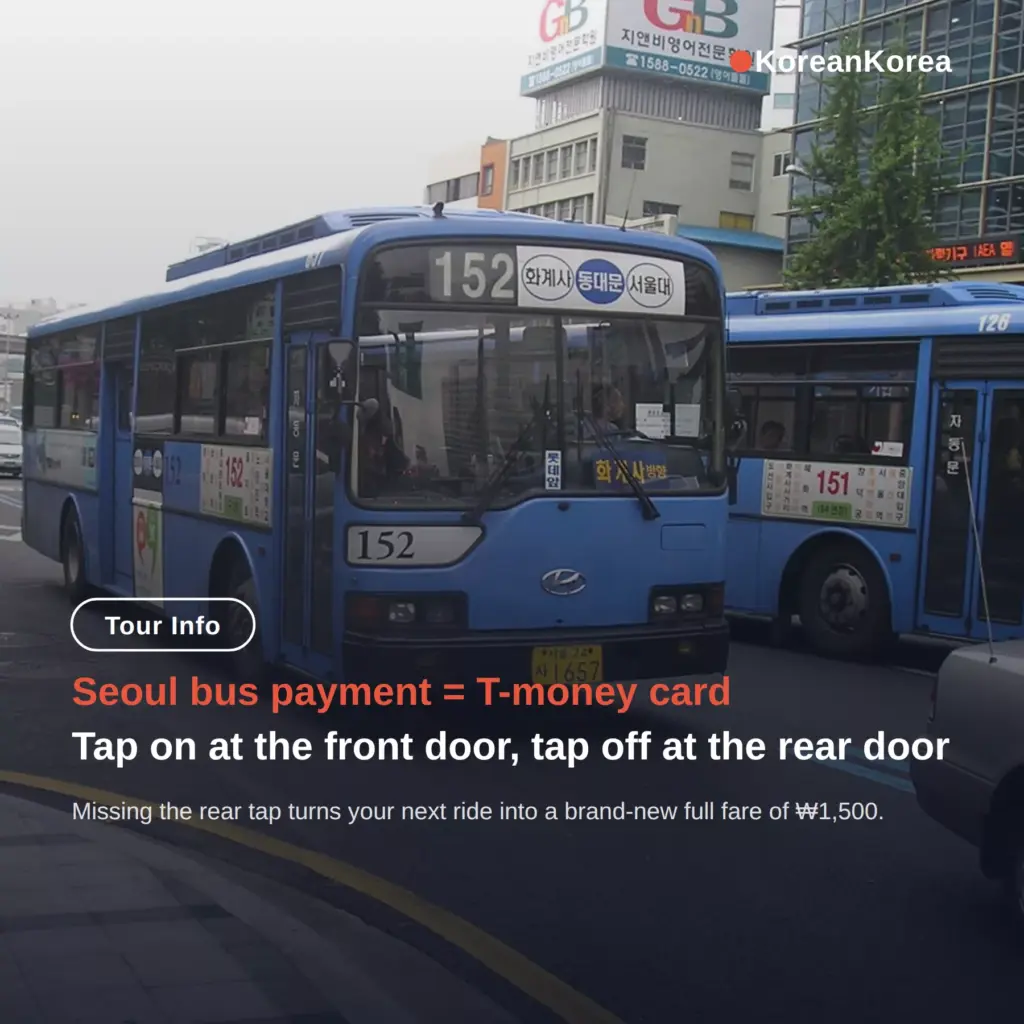
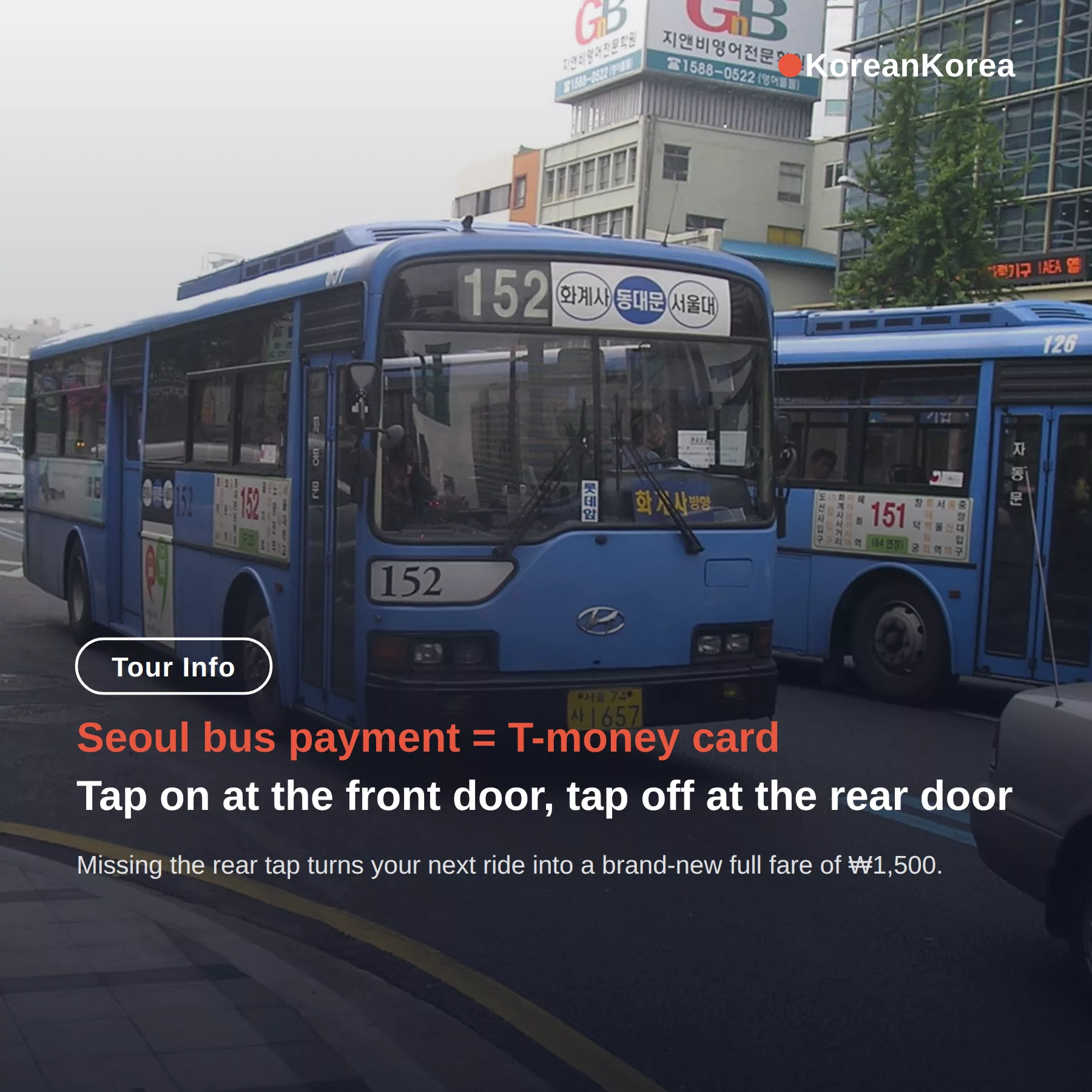
Pay for a Seoul bus with a T-money card: tap on at the front door, tap off at the rear door — the July 2026 adult card fare is ₩1,500.
Contents
- How to pay for bus in Seoul: tap on at the front, tap off at the rear with T-money
- Can I use a foreign credit card or cash on Seoul buses?
- T-money card: where to buy, how much, how to top up
- Seoul bus fares in 2026: by type, by age, card vs cash
- How free transfers work — and what happens if you forget to tap off
- T-money vs WOWPASS vs Climate Card: which one for your trip
How to pay for bus in Seoul: tap on at the front, tap off at the rear with T-money
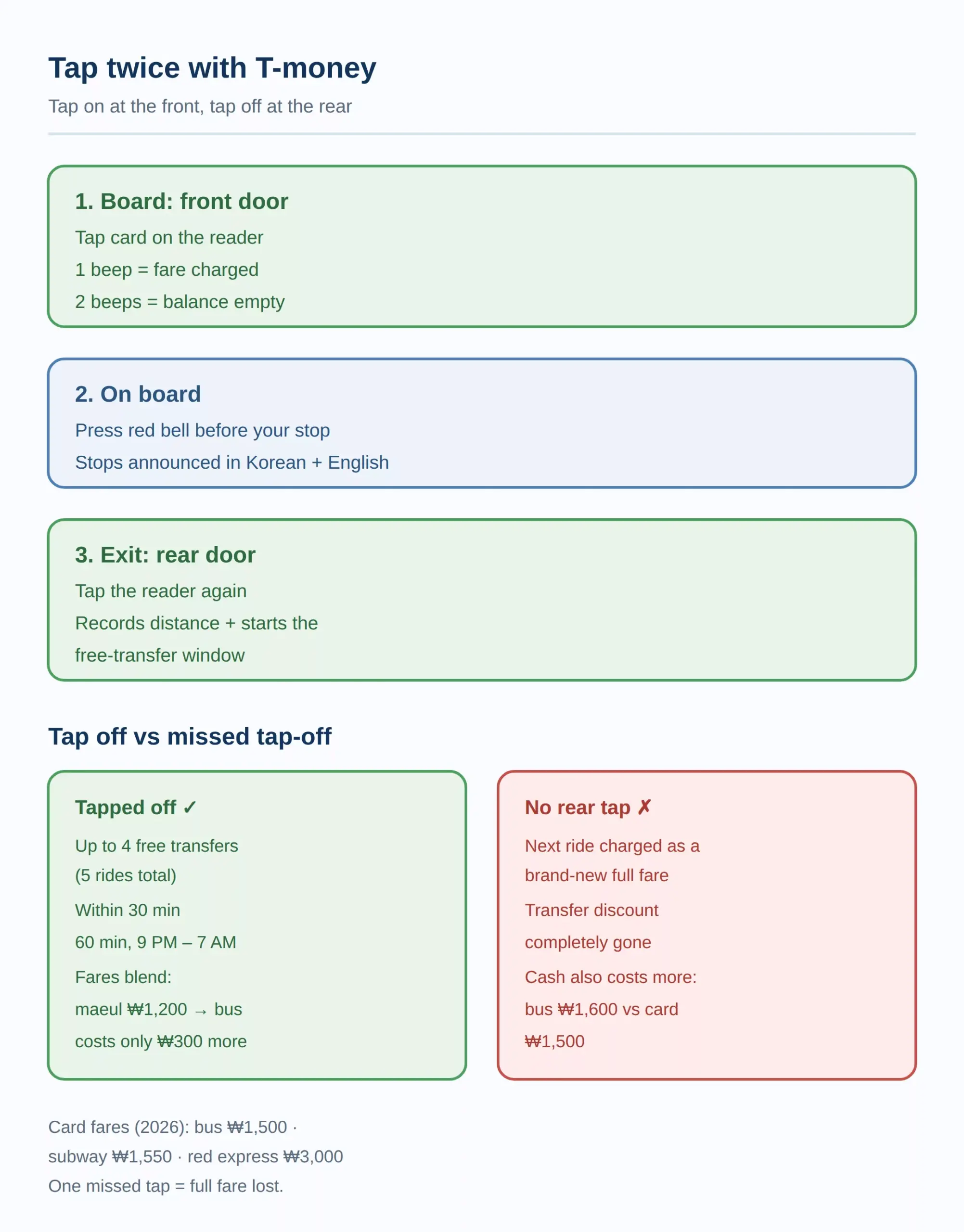
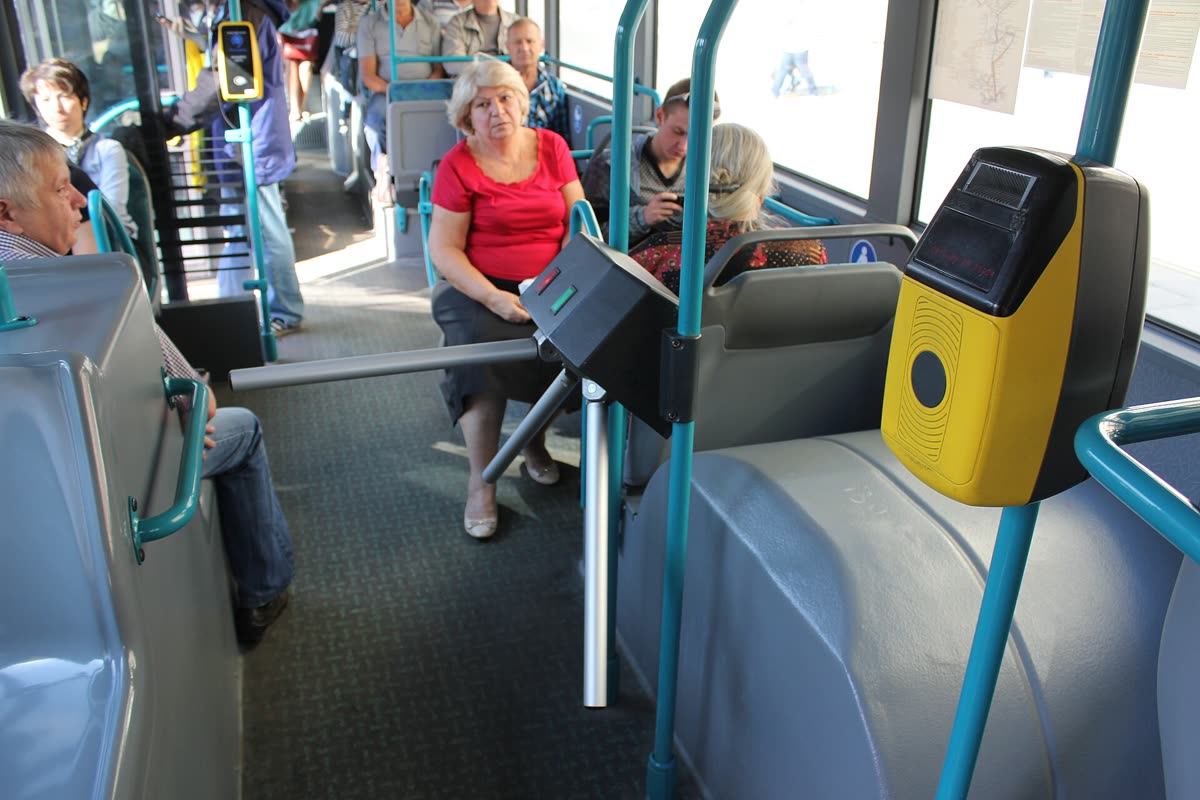
Pay by tapping a T-money card on the reader at the front door when you board, and tap again on the rear-door reader as you get off.
The second tap records how far you rode and starts the free-transfer window — without it, your next ride becomes a brand-new full fare.
- Board through the front door and tap your card on the reader.
- Press the red bell one or two stops before yours; most routes announce stops in Korean and English.
- Exit through the rear door and tap the reader again on your way out.
When I check a bus payment question like this, I look first at what the rider physically does at the two doors, because that is where visitors lose money.
If the reader beeps once, the fare was charged and the balance shows on the display; two sharp beeps usually mean the balance is empty.
If you plan several rides in a day, the tap-off rule matters more than the fare itself — one missed tap costs you the whole transfer discount.
| Blue (trunk) | ₩1,500 |
|---|---|
| Green (branch) | ₩1,500 |
| Yellow (circular) | ₩1,400 |
| Maeul (village) | ₩1,200 |
| Red (express) | ₩3,000 |
| Night (N / Owl) | ₩2,500 |
Can I use a foreign credit card or cash on Seoul buses?
No — foreign contactless credit cards do not work on Seoul buses, and you should assume cash is not accepted either.
The bus readers run on a closed stored-value transit-card system, not the open contactless scheme your Visa or Mastercard uses at home, so the tap fails no matter how new the card is.
Seoul has been converting routes to fully cashless operation since 2023, and cash boarding was discontinued on converted routes from the second half of 2024.
What is not confirmed is exactly which routes, if any, still take cash as of September 2026 — the safe assumption is that they do not.
If you were planning to wave a credit card at the reader, get a T-money card first; if you have no card and no cash, look for the payment notice posted inside the bus rather than expecting the driver to take bills.
👉 Can I Use Apple Pay in Korea Subway? Yes, With a T-money Card in Apple Wallet
T-money card: where to buy, how much, how to top up
A T-money card costs ₩2,500–₩4,000 for the card itself at any convenience store, and the traveler-oriented T-money Travel Card sells for ₩4,000.
Buy one at CU, GS25, or 7-Eleven (most are open 24 hours), at subway station kiosks or customer centers, or at the arrival concourses of Incheon and Gimpo airports.
The card price is not fare credit — charge it separately.
Top up with cash at the same convenience stores or at subway recharge machines, and know that machines and most stores historically reject foreign cards.
As of May 2026, upgraded kiosks that accept international Visa, Mastercard, and UnionPay for recharge were live at Seoul Station, Hongdae, Myeongdong, Gangnam, and hubs on Lines 1, 2, and 9.
T-money also works on the subway, many taxis in central Seoul, convenience-store purchases, and station lockers, and the card can be registered in Apple Pay or Samsung Pay.
If you are landing at Incheon or Gimpo with no Korean cash, buy the card at the arrivals concourse first and keep some cash for topping up; note that if you leave Korea with money still on the card, the refundable amount and any fees depend on where and how you request it, so plan your top-ups to match what you will actually spend.
Seoul bus fares in 2026: by type, by age, card vs cash
By the July 2026 fare table, an adult pays ₩1,500 by card on a blue or green bus, ₩1,400 on a yellow circular, ₩3,000 on a red express, and ₩2,500 on a night (N/Owl) bus.
Transit-card payment is ₩100 cheaper than cash on every mode — city bus ₩1,500 vs ₩1,600, subway ₩1,550 vs ₩1,650 — and cash riders get no transfer discount at all.
Age discounts need a registered card with your birthdate: teens (13–18) pay ₩960 and children (6–12) pay ₩480 on city buses, with riders 65 and over riding free on Seoul city, maeul, and subway.
The base fare covers the first 10 km on standard city routes, and ₩100 is added per extra 5 km beyond that on integrated routes.
A typical day of getting around costs ₩3,000–₩6,000 (about $2–5).
If your card has no Korean registration, expect the full adult fare; the subway one-time ticket (₩2,000 including a ₩500 refundable deposit) exists only on the subway, not on buses.
How free transfers work — and what happens if you forget to tap off
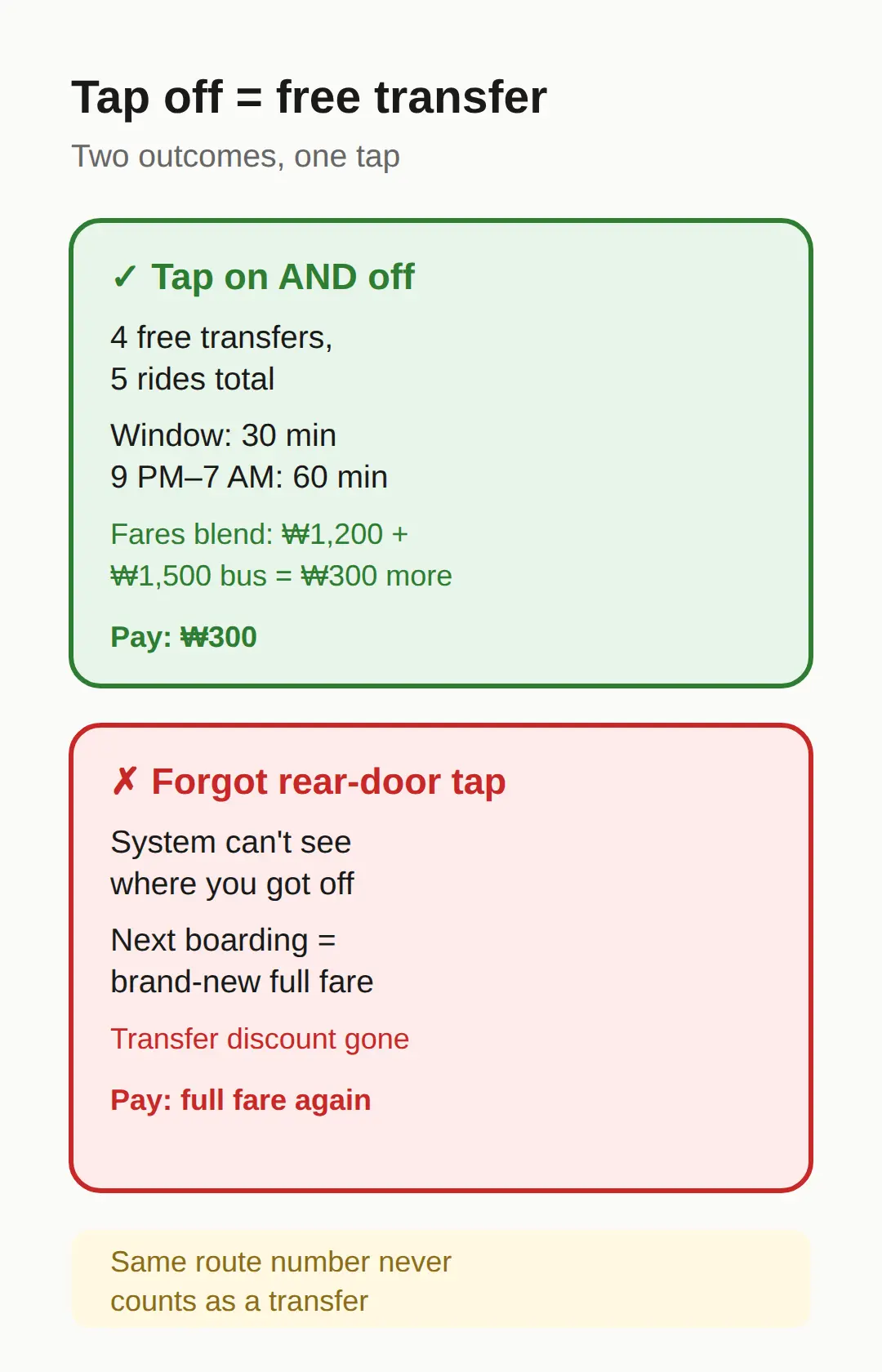
You get up to 4 free transfers (5 rides total) within 30 minutes of your first tap, and the window stretches to 60 minutes between 9 PM and 7 AM.
Different fare classes blend instead of stacking: transferring from a ₩1,200 maeul bus to a ₩1,500 city bus charges only the ₩300 difference.
The alighting tap is what makes this work — it tells the system where your last ride ended and starts the transfer clock.
Re-boarding the same route number does not count as a transfer, so you cannot loop back on the same bus for free.
Skip the rear-door tap and the system cannot see where you got off, so your next boarding is charged as a brand-new full fare and the discount is gone.
If your connection is a different route within half an hour, tap off properly and the transfer is free; if you plan to re-board the same number, budget for a second full fare.
👉 Seoul fireworks festival 2026 subway: Which Stations to Use Tonight
T-money vs WOWPASS vs Climate Card: which one for your trip
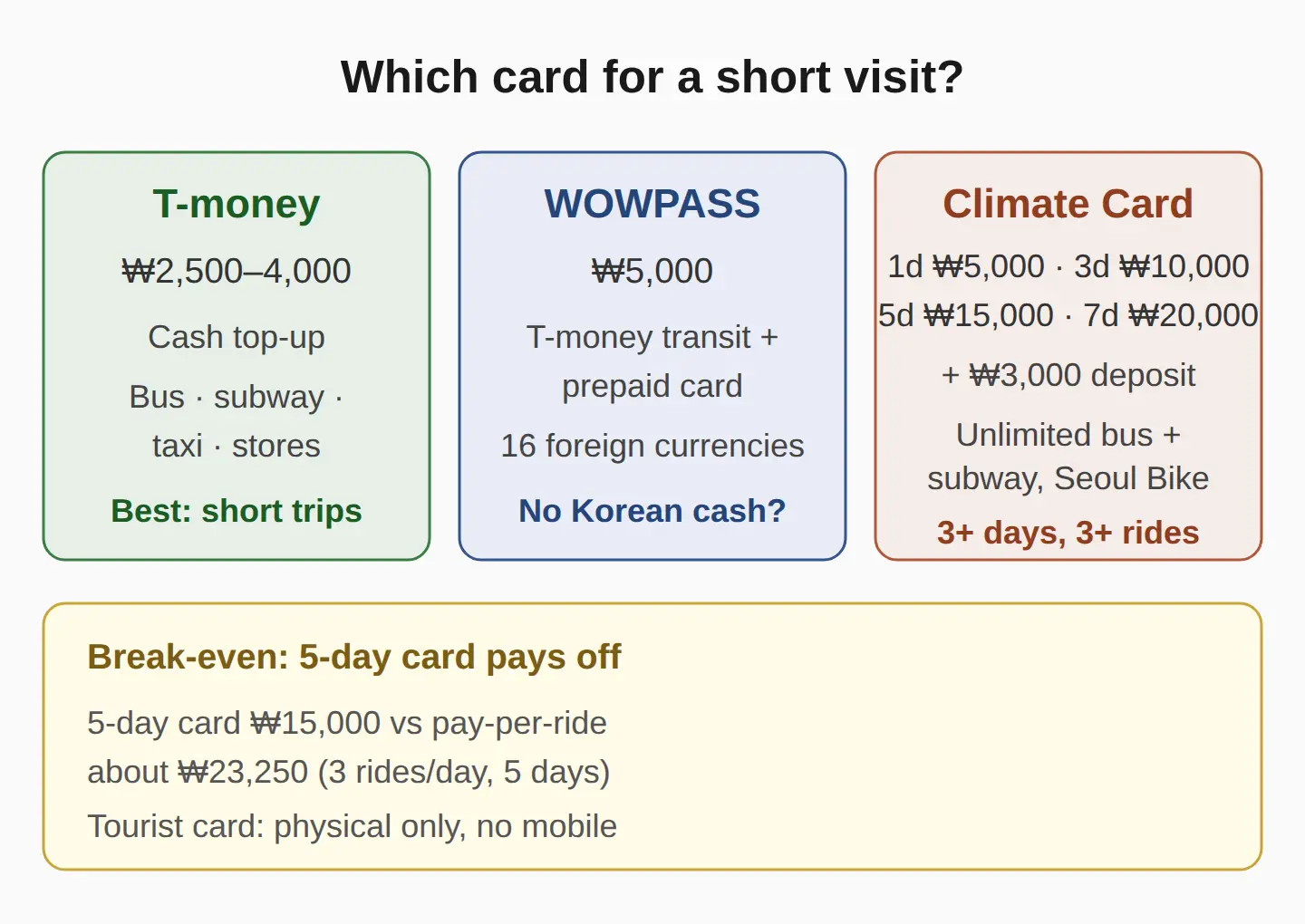
For a short visit, plain T-money covers almost everyone; the Climate Companion Card wins from 3 days of heavy riding, and WOWPASS is the pick if you arrive with no Korean cash.
T-money is ₩2,500–₩4,000 for the card, cash-topped-up, and works on buses, subway, taxis, and stores.
WOWPASS costs ₩5,000 and bundles T-money transit with a prepaid payment card that can be topped up with foreign currencies (16 are supported, per one source).
The Climate Card is ₩5,000 for 1 day, ₩10,000 for 3 days, ₩15,000 for 5 days, ₩20,000 for 7 days, plus a ₩3,000 deposit, and covers unlimited subway and bus rides including Seoul Bike.
The break-even math: at about 3 rides a day (roughly ₩4,650/day on T-money), the 5-day card at ₩15,000 beats pay-per-ride at about ₩23,250, so it pays off from around 3 days on.
The tourist Climate Card is a physical card only — there is no mobile version for visitors — and it is sold at subway Lines 1–8 customer safety rooms, the Myeongdong tourist information center, and convenience stores.
The 30-day price needs a recheck against the official Seoul page, so treat listed 30-day figures with caution.
For a trip of 3 days or more with 3 or more rides a day, I would get the 5-day Climate Companion Card at ₩15,000 plus the ₩3,000 deposit — cheaper than about ₩23,250 in pay-per-ride fares.
Shorter or lighter trips should just use T-money.
👉 Seoul bus guide covering cashless boarding and the bank-transfer fallback inside buses
👉 T-money travel card prices and what the balance refund rules are
👉 Seoul transportation guide with Climate Card tourist pass prices and Apple Pay T-money
👉 Bus type fares, transfer window rules and fare blending explained
👉 Where to buy T-money cards for foreigners across Korea’s transit system
Related posts
📎 Seoul — everything we know
📎 Gyeongbokgung night tour 2026: 3,000 won, Sept 2-Oct 2, and how booking works
📎 Korail Pass seat reservation during Chuseok 2026: valid but standing — how to lock a seat
📎 📅 다가오는 일정 — 발매·개봉·발표 캘린더
Sources
- Routes converting to cashless since 2023; foreign cards don’ (kstayguide.com)
- Cash boarding discontinued since late 2024; bank-transfer fa (svhohk.tistory.com)
- Boarding/alighting steps, driver top-up possible, stop annou (wisefullife.com)
Practical notes for the bus stop
- Buy your T-money card at any CU, GS25 or 7-Eleven for about ₩3,000, then load it with cash before your first ride.
- Seoul buses skip stops when nobody signals — step toward the curb or raise a hand as the bus approaches.
- Remember the beeps: one beep means the fare was charged; two sharp beeps usually means your balance is empty.
- Traveling 3 days or more? The Climate Card tourist pass may cost less than paying per ride.
FAQ
Q. Do you tap twice on Seoul buses — once on, once off?
Yes. Tap at the front door on boarding and at the rear door on exit; the second tap records your distance and starts the free-transfer window (30 minutes, or 60 minutes between 9 PM and 7 AM).
Q. Can I use a foreign credit card on Seoul buses?
No. Seoul buses run on a closed stored-value transit-card network (T-money), not an open EMV contactless scheme like London’s, so foreign contactless cards fail at the reader.
Q. Do Seoul buses take cash?
Assume no. Routes have been converting to fully cashless since 2023, with cash boarding discontinued from the second half of 2024; which routes, if any, still take cash in 2026 is not clearly listed.
Q. What happens if I forget to tap off a Seoul bus?
The system cannot see where your last ride ended, so your next boarding is charged as a brand-new full fare and the transfer discount disappears.
Q. Which transit card should a short-term visitor buy — T-money, WOWPASS, or Climate Card?
Under 3 days, buy a T-money card (₩2,500–₩4,000) and top it up with cash. Riding 3+ times a day for 3 days or more, the 5-day Climate Companion Card (₩15,000 plus ₩3,000 deposit) beats pay-per-ride; WOWPASS (₩5,000) suits arrivals with no Korean cash.
Before your first ride, find your route on Naver Map, note the 5-digit stop ID at the shelter, and buy the T-money card at the airport arrivals concourse before you need it.
Cover photo: Seoul City Bus 152 by STA3816 — CC BY-SA 3.0
#Seoulbus #T-money #Koreatransit #ClimateCard #WOWPASS #Koreatraveltips
📅Upcoming Dates — 이번 주 16 · D-day 'The Scandal' global Netflix release전체 보기 →